
Blog / Used Cars for Sale

Used Vehicles That Make Sense for Commuters and Families of Five

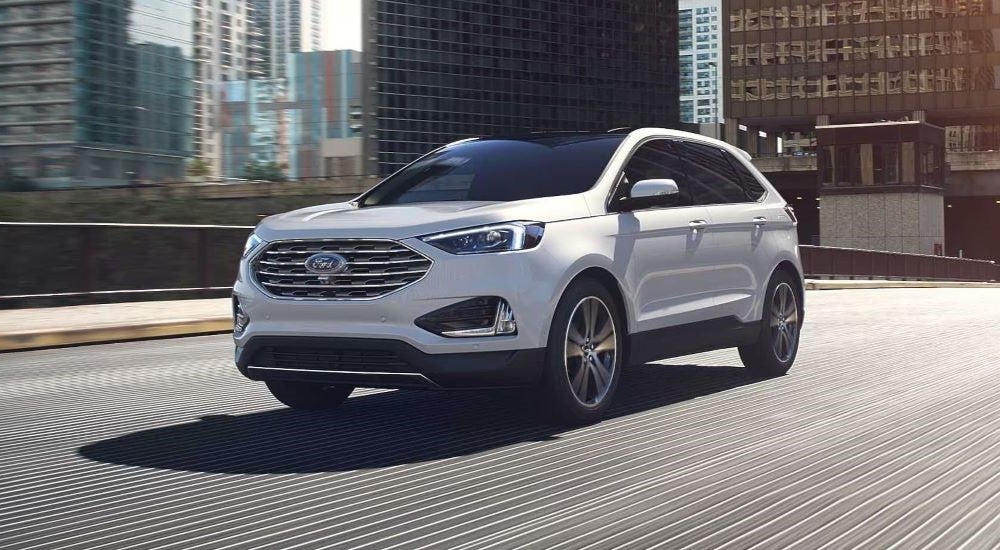
White 2024 Ford Edge driving over a bridge.

Finding the right vehicle for a family of five can feel like a balancing act. The vehicle needs enough passenger space for school runs, appointments, activities, and weekend trips, but it may also spend much of the week carrying one person to and from work. Choosing a vehicle more than the family needs can increase fuel, insurance, and maintenance expenses, while choosing too little space can make every outing uncomfortable.

Upstate New York drivers face additional considerations. Snow, freezing rain, steep roads, potholes, and rapidly changing weather can make traction and predictable handling important. Available all-wheel drive or four-wheel drive may be useful, although neither system replaces suitable tires, careful braking, and speed appropriate for the conditions.

The good news is that shoppers comparing used cars for sale have several practical options. Our inventory often includes Ford Escape, Edge, Explorer, Bronco Sport, and Subaru Forester models. Our connection to Chrysler dealerships also makes the Pacifica a realistic pre-owned option. Looking at recent model years from the latest generation or collection of each vehicle can help families find modern safety, comfort, and convenience features without limiting the search to one exact year.

Ford Escape: An Adaptable Compact SUV

A more recent Ford Escape may suit a commuter who wants SUV versatility without the size of a three-row vehicle. It seats five and provides a rear cargo area that can accommodate groceries, backpacks, luggage, and other household essentials. Its compact exterior can also be easier to park and maneuver during the workweek than a larger family SUV.

Recent Escape models have front-wheel drive or available all-wheel drive, depending on the powertrain and trim. Gas, hybrid, and plug-in hybrid versions may also appear in the used market. That variety allows commuters to compare conventional performance with electrified options that may reduce fuel use under appropriate driving and charging conditions.

One of the Escape's most useful family features is its sliding second row. Moving the seat rearward can provide more passenger room, while sliding it forward creates additional cargo space. This flexibility is helpful when the vehicle sometimes carries five people and sometimes carries one or two people with more gear.

The Escape is still a compact SUV, so families should test the rear seat carefully. Three teenagers or multiple child safety seats may feel tight. Bring the seats, stroller, sports bags, or instruments that the vehicle will regularly carry before deciding whether the Escape provides enough room.

Ford Edge: More Space Without a Third Row

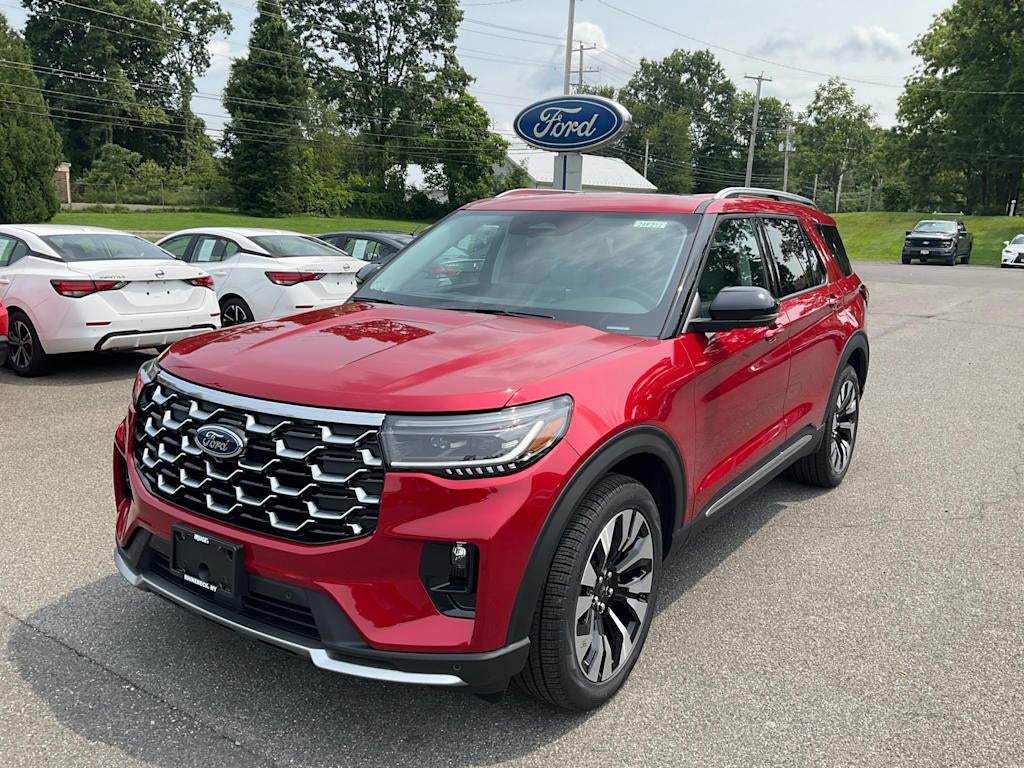
A recent Ford Edge can be a strong middle-ground option for a five-person family. Our inventory network often features pre-owned Edge models, including versions equipped with all-wheel drive. Although Ford concluded Edge production after the 2024 model year, late examples from its final collection remain relevant to used-SUV shoppers.

The Edge has two rows and seating for five. Its wider cabin may make it more comfortable for three passengers sharing the rear bench than a smaller crossover. Because there is no third row occupying the back of the vehicle, the Edge also provides a large, straightforward cargo area for school gear, groceries, luggage, and weekend supplies.

This layout works well for a family that wants more room than the Escape provides but does not expect to transport six or seven people. It can also be easier for a commuter to manage than a longer three-row SUV.

The tradeoff is that a midsize vehicle generally brings higher fuel and tire costs than a compact crossover. Shoppers should compare those expenses with the practical benefit of the wider cabin. If five people will regularly travel together, the extra room may be worth more than a small difference in operating costs.

Ford Explorer: Three-Row Flexibility for Busy Households

For families that carpool, travel with relatives, or simply want room to spread out, a recent-generation Ford Explorer deserves consideration. Current and recent Ruge's inventories have included multiple pre-owned Explorer models, making it one of the most realistic examples for this topic.

The Explorer offers three rows and seating for up to seven, depending on whether the second row has captain's chairs or a bench. A family of five may not need every seat, but the third row creates useful flexibility. One child can move to the back on a long trip, a friend can join the family, or the third row can fold when cargo space is the priority.

Recent Explorer models have also been offered with available Intelligent 4WD and selectable drive modes. Those features may appeal to drivers preparing for the changing upstate New York road conditions. Equipment varies by year and trim, so shoppers should confirm the drivetrain and drive modes on the individual vehicle.

Before choosing an Explorer, families should test third-row access with any child-safety seats installed. They should also determine how much cargo room remains when every row is upright. The Explorer is best for households that will genuinely benefit from its flexible seating rather than commuters who would drive with two empty rows most of the time.
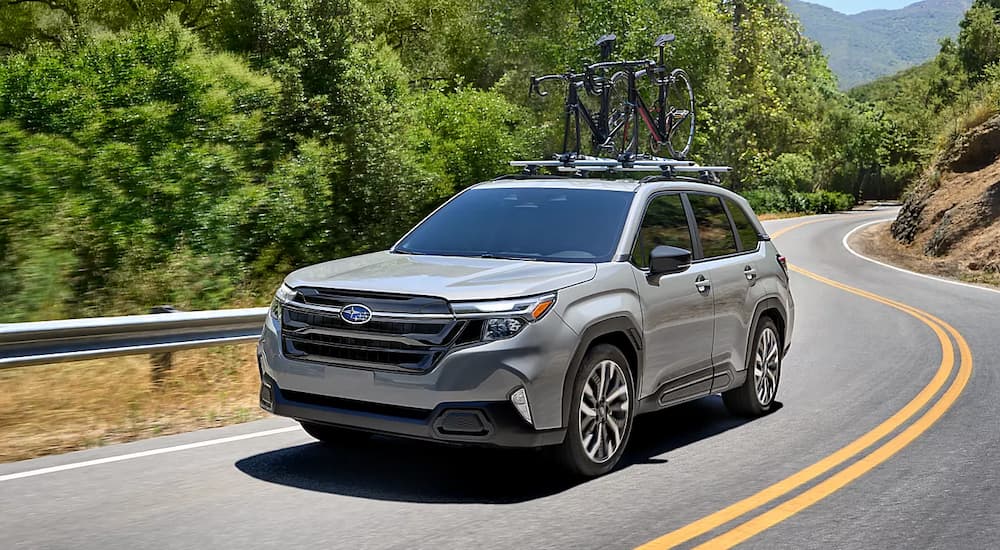
Silver 2025 Subaru Forester driving around a bend.

Subaru Forester: Practical Space and Standard AWD

Our broader pre-owned inventory frequently includes Subaru vehicles, making a recent-generation Forester another realistic option. The latest Forester design seats five and includes standard Symmetrical All-Wheel Drive across its lineup.

The Forester's taller shape supports good passenger space and a useful cargo area without giving the vehicle an especially large footprint. Wide door openings can make it easier to load children or install child-safety seats, while the rear liftgate provides access for strollers, luggage, or sports equipment.

Recent Forester models also include Subaru EyeSight driver-assistance technology as standard equipment. The exact functions can vary, but shoppers may encounter features designed to assist with braking, lane positioning, and following distance. These systems can support an attentive driver during a long commute, although they are not substitutes for driver awareness.

The Forester may appeal most to families that want all-wheel drive, a tall cabin, and manageable exterior dimensions. As with the Escape, the second row should be tested with all three expected passengers to confirm that the width works for the family.

Chrysler Pacifica: A Family-Focused Alternative

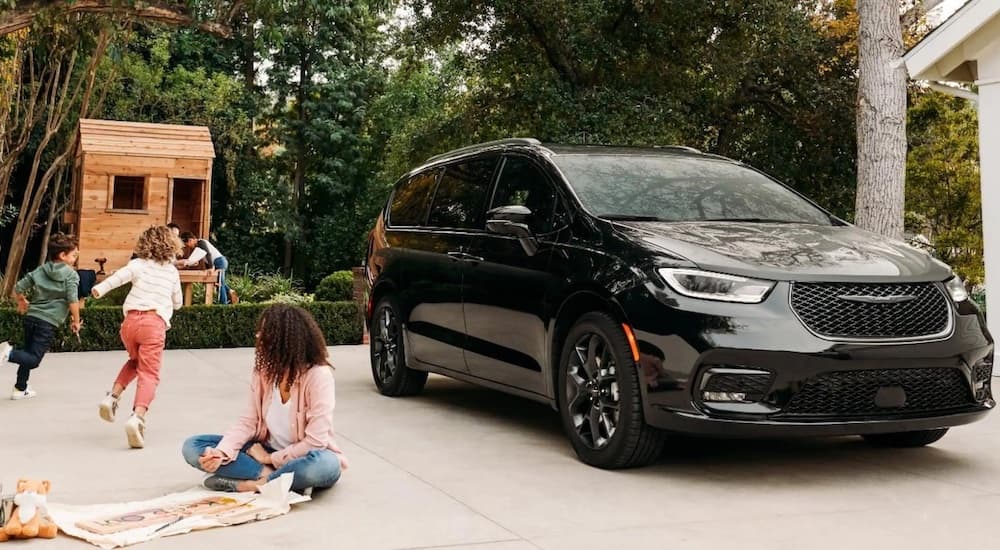
A Chrysler Pacifica may not be the first vehicle every commuter considers, but it can be one of the most practical choices for a family of five. Because our dealership network includes Chrysler, Dodge, Jeep, and Ram operations, late-model Pacifica minivans are also often available in our inventory.

Recent Pacifica models can seat up to eight, depending on configuration. Sliding side doors make it easier to load passengers in narrow parking spaces, while the flexible interior provides room for school bags, sports equipment, luggage, and other family cargo.

Available all-wheel drive distinguishes the Pacifica from many traditional minivan expectations and is ideal for upstate New York families. However, drivetrain and seating features vary, so shoppers should verify the equipment on each vehicle.

The Pacifica is larger than a compact SUV, and commuters should consider its fuel, tire, and insurance costs. In return, it can reduce many of the small frustrations associated with family transportation. Parents may spend less time rearranging cargo, separating passengers, or squeezing between parked vehicles to open a conventional rear door.

Compare the Complete Ownership Picture

Once a family identifies the right vehicle type, the condition of the individual's used vehicle becomes more important than the model name alone. Review its maintenance records and vehicle history report, and consider a pre-purchase inspection. Because winter road treatments are common in our area, the underbody, suspension, brakes, and exposed metal components deserve close attention.

Safety features also vary across model years and trims. Confirm whether the specific vehicle includes automatic emergency braking, blind-spot monitoring, rear cross-traffic alert, adaptive cruise control, lane assistance, or other desired systems. Never assume that every example from the same generation has identical equipment.

Finally, compare fuel, insurance, maintenance, repair, and replacement-tire estimates. The smaller Escape or Forester may help control commuting expenses. The Edge provides additional width without a third row. The Explorer offers adaptable seating, while the Pacifica delivers maximum family functionality.
Black 2023 Chrysler Pacifica parked on a driveway.

Choose for the Commute and the Whole Family

No single model will suit every household. The best choice is the vehicle that works when the driver is alone on Monday morning and when all five family members are aboard on Saturday.

When exploring used cars for sale, families should recreate their normal routine during the evaluation. Install the child seats, bring the stroller or sports bags, sit three people across the rear seat, and drive on roads similar to the daily commute. That practical test can reveal whether a vehicle offers the right balance of comfort, space, winter-ready confidence, and manageable ownership costs.
Posted in:

Recommended Posts

Towing Camper

F-150 Towing Guide for Ruge's Ford

2026 Ford F-150 Towing Guide: Capacity by Trim and Engine Whether you're pulling a boat to the Hudson, a camper up to the Catskills, or a work trailer across the county, the F-150 has a setup for it. The trick is that trim level is only part of the story. Your towing number really comes down to engine, cab, bed length, axle ratio, drivetrain and whether you add the Tow/Haul Package. Here's how it all breaks down, straight from Ford's official specs. Max towing by engine Engine Max Conventional Towing Max Payload 2.7L EcoBoost V6 8,400 lbs 1,775 lbs 3.5L EcoBoost V6 13,500 lbs 2,440 lbs 5.0L Ti-VCT V8 12,800 lbs 2,235 lbs 3.5L PowerBoost Full Hybrid V6 12,400 lbs (4x2) / 11,600 lbs (4x4) 1,740 lbs 3.5L High Output EcoBoost V6 (Raptor) 8,200 lbs 1,405 lbs 5.2L Supercharged V8 (Raptor R) 8,700 lbs 1,410 lbs The top ratings for the 3.5L EcoBoost, 5.0L V8 and PowerBoost all require Tow/Haul Package and Max Tow Axle upgrade. One more thing to keep in mind: horsepower, torque, payload and towing are independent attributes and may not be achieved simultaneously. Engine availability and top tow rating by trim Trim Available Engines Highest Engine Rating Available XL 2.7L EcoBoost, 5.0L V8, 3.5L EcoBoost 13,500 lbs (3.5L EcoBoost) STX 2.7L EcoBoost, 5.0L V8, 3.5L PowerBoost 12,800 lbs (5.0L V8) XLT 2.7L EcoBoost, 5.0L V8, 3.5L EcoBoost, 3.5L PowerBoost 13,500 lbs (Ford's named max tow config) Lariat 5.0L V8, 3.5L EcoBoost, 3.5L PowerBoost 13,500 lbs (3.5L EcoBoost) Tremor 5.0L V8, 3.5L EcoBoost 10,600 lbs (3.5L EcoBoost, Tremor rating) King Ranch 3.5L EcoBoost, 3.5L PowerBoost 13,500 lbs (3.5L EcoBoost) Platinum 3.5L EcoBoost, 3.5L PowerBoost 13,500 lbs (3.5L EcoBoost) Raptor 3.5L High Output EcoBoost 8,200 lbs Raptor R 5.2L Supercharged V8 8,700 lbs A quick heads up: the top ratings above apply to the best-equipped configurations. Ford notes that your specific vehicle's tow capability could be reduced based on weight of selected trim series and option content. So a loaded Platinum won't always match an XLT with the same engine. That's exactly why it's worth sitting down with our team to spec the right truck. Ford What you need to hit max towing For gas trucks, Ford requires the Tow/Haul Package (53T) plus the optional Max Tow Axle for trailers over 11,600 lbs. For the hybrid, the threshold is for trailers over 10,800 lbs. Ford also warns that your New Vehicle Limited Warranty may be voided if you tow without them. 2026 Ford F-150 Towing Information +2 The Tow/Haul Package includes the integrated trailer brake controller and either the 3.55 or 3.73 e-lock rear axle depending on the powertrain. Ford The hitch receiver also changes with the package. A 2" hitch receiver rated at 11,600 lbs. is standard. Max Tow Axle includes 2" reinforced receiver rated at 14,000 lbs. Ford Weight rules worth knowing Use weight distribution over 5,000 lbs. Do not exceed trailer weight of 5,000 lbs. when towing without a weight-distribution system. Ford Tongue weight should be about 10% of the trailer. Trailer tongue load weight should be 10% of total loaded trailer weight. For 5th-wheel and gooseneck trailers, the king pin load should be 15% of total loaded trailer weight. Ford Ford Count people and cargo against payload. Your payload has to cover the tongue weight, your passengers and whatever's in the bed. Watch the trailer's frontal area. Ford's limit is 55 sq. ft. for vehicles with Trailer Tow Rating of 7,700 lbs. or less, 65 sq. ft. for vehicles with Trailer Tow Rating of 7,701 lbs. and greater and 75 sq. ft. for all 5th-Wheel and Gooseneck applications. Ford Heading into the mountains? At elevation, Ford recommends you reduce Gross Vehicle Weight (GVW) and Gross Combination Weight (GCW) by 2% per 1,000 ft. elevation. Ford Bring a matching spare. A conventional, identical full-size spare tire is required for trailer towing. Ford Raptor owners, skip the 5th-wheel. 5th-wheel towing is not recommended for Raptor model. Ford Towing tech that makes life easier Every F-150 comes with trailer sway control, a 7-wire harness, a hitch receiver, a transmission oil cooler and Tow/Haul mode. The Lariat and up add a 360-Degree Camera, Pro Trailer Backup Assist and Pro Trailer Hitch Assist as standard. With Pro Trailer Backup Assist, you simply rotate in the direction you want the trailer to go, and it'll move your truck and trailer into position. Pro Trailer Hitch Assist steers, accelerates and brakes for you, as it guides your truck into place for easy hitching to your conventional trailer. Towing FAQ What's the max towing capacity of the 2026 F-150? 13,500 lbs with the 3.5L EcoBoost V6. Ford's top configuration is the XLT SuperCrew 4x4 with the 6.5' box, the Tow/Haul Package and the Max Tow Axle. How much can the F-150 hybrid tow? Up to 12,400 lbs on a 4x2 SuperCrew and up to 11,600 lbs on a 4x4, when properly equipped. How much can the F-150 Tremor tow? Up to 10,600 lbs with the 3.5L EcoBoost and 10,000 lbs with the 5.0L V8. Do I need the Tow/Haul Package? If you're towing over 11,600 lbs with a gas engine, or over 10,800 lbs with the hybrid, yes. You'll need the Tow/Haul Package and the Max Tow Axle. Where do I find my truck's exact ratings? See label on doorjamb for carrying capacity of a specific vehicle. The axle code is on the same Safety Compliance Certification Label. Or just stop by, and we'll walk through it with you!

Ford Tires

When Should You Switch to Winter Tires in the Hudson Valley?

Here in the Hudson Valley, winter has a way of sneaking up on you. One week you're driving past apple orchards in a light jacket, and the next you're scraping frost off the windshield before sunrise in Rhinebeck. A lot of drivers wait for the first real snowfall to think about winter tires. By then, the tire shops are slammed and you've already done a few mornings on tires that weren't built for the cold. So when's the right time to switch? Here's how we think about it at Ruge's Ford, and what we tell our service customers from Red Hook to Hyde Park. Go by the thermometer, not the snow The rule of thumb from tire makers like Michelin is simple: once daytime temperatures consistently stay below 45 degrees, it's time for winter tires. Why 45? All-season tires start to stiffen up as the air gets colder. Stiff rubber doesn't grip the road as well, even when the pavement is dry. Winter tires use a softer compound that stays flexible in the cold, plus deeper tread and extra siping to bite into snow and slush. For most of Dutchess and Ulster County, that usually lands somewhere between late October and mid-November. If you commute early or drive the higher roads out toward Milan and Pine Plains, you'll probably feel it sooner. Quick answer Book your winter tire swap for when highs are sitting in the 40s, not after the first storm. In the Rhinebeck area, late October is a smart target. What about studded tires in New York? If you run studded snow tires, New York has a set window for them. They're allowed from October 16 through April 30. Outside of those dates, studs have to come off. Standard winter tires without studs aren't bound by those dates, but there's no reason to run them in summer heat. They wear quickly on warm pavement, so plan on swapping back in the spring. "I've got 4x4. Do I really need winter tires?" We hear this one a lot, especially from F-150, Bronco, and Explorer owners. It's a fair question, and the honest answer is that four-wheel drive and winter tires do different jobs. 4WD and AWD help you get moving. They send power to the wheels that have grip, which is great for pulling out of an unplowed driveway or climbing a slick hill. But they don't help you stop, and they don't help much when you're turning on ice. That comes down to the four small patches of rubber touching the road. Think about the Kingston-Rhinecliff Bridge on a cold morning, or the curves on the Taconic after a freeze. Those are braking and steering moments. That's where winter tires earn their keep, no matter what's sending power to the wheels. Always go with a full set of four It's tempting to save a little and put winter tires on just the front or just the rear. Please don't. Mixing winter tires with all-seasons gives you uneven grip front to back, which can make the vehicle harder to control when you need it most. Four matching winter tires keep everything balanced. Don't forget your tire pressure Cold air takes up less space, so your tire pressure drops as the temperature falls. The general figure is about 1 PSI for every 10 degrees. Tires you set in September can easily be a few PSI low by the first hard frost. That's usually why your tire pressure light pops on during a cold morning and then goes off after a few miles. The tires warm up and the pressure comes back, but they're still low the next time they cool down. Check your pressure once a month through the winter, using the number on your driver's door jamb, not the max on the tire sidewall. A few more Hudson Valley winter basics While your Ford is in for tires, it's a good time to knock out the rest of your winter checklist: Battery test. Cold weather is hard on batteries, and it's no fun finding out in a parking lot at 6 a.m. Wiper blades and washer fluid. Road salt spray builds up fast on Route 9. Fresh blades and a winter-rated fluid make a big difference. Brakes. Winter driving asks a lot of your brakes. A quick inspection now beats a surprise later. Headlights. In New York, if your wipers are on because of the weather, your headlights need to be on too. And keep a small kit in the vehicle: an ice scraper, a brush, a blanket, jumper cables, and a phone charger. Let Ruge's Ford Get You Ready for Winter Our service team in Rhinebeck works on Fords every day, from Mavericks to Super Duty trucks. We can help you pick the right winter tires for how you drive, mount and balance them, check your pressure, and take care of the rest of your winter checklist in the same visit. Short on time? Ask us about our pickup and delivery service when you book. The earlier you schedule, the easier it is to get the day you want before the rush. Winter Tire FAQs When should I put winter tires on in the Hudson Valley? Once daytime temperatures are consistently below 45 degrees. Around Rhinebeck and the rest of Dutchess County, that's usually late October to mid-November. When are studded tires legal in New York? Studded snow tires are allowed in New York from October 16 through April 30. Do I need winter tires if my Ford has 4WD or AWD? They're still worth it. 4WD and AWD help you accelerate, but they don't help you brake or steer on snow and ice. Winter tires do. Can I just put two winter tires on? We don't recommend it! Mixing winter tires with all-seasons creates uneven grip and can make the vehicle harder to control. Go with a set of four. Why does my tire pressure light come on when it gets cold? Tire pressure drops about 1 PSI for every 10 degree drop in temperature. Add air to the pressure listed on your driver's door jamb, and check it monthly through the winter.

2027 Ford Explorer: What to Love

If you've spent any time on Route 9, the Taconic, or a gravel road heading toward a trailhead, you already know why the Explorer has been a Hudson Valley staple for so long. It's the rare three-row SUV that hauls the whole family without feeling like a chore to drive. The 2027 Ford Explorer keeps everything that made that reputation, and adds a few things worth getting excited about. Here's what we love about it, and who each version is really built for. It Still Drives Like Something You Chose, Not Settled For This is the part people underestimate until they get behind the wheel. The Explorer is built on a rear-wheel-drive platform, which is unusual in this class, and you can feel it. The steering has actual weight to it. The nose doesn't wash out when you take an on-ramp with a little enthusiasm. It just feels planted in a way a lot of family SUVs don't. Two turbocharged EcoBoost engines carry the lineup. The 2.3L EcoBoost four-cylinder is standard on Active, ST-Line, Tremor, and Platinum, and it puts out 300 horsepower and 310 lb-ft of torque on premium fuel. That's genuinely plenty. It's not a base engine you tolerate, it's an engine you'd pick on purpose. Step up to the 3.0L twin-turbocharged EcoBoost V6 and you get 385 horsepower and 415 lb-ft, again on premium. It's standard on the ST and available on the Tremor. Both engines pair with a 10-speed automatic, and both offer rear-wheel drive with available Intelligent 4WD. You also get up to six selectable drive modes: Normal, Eco, Sport, Tow/Haul, Slippery, and either Trail or Off-Road depending on the model. Slippery alone earns its keep around here. Ask anyone who's driven Route 199 in February. The Tremor Is the One We Keep Talking About The Explorer Tremor is the model that surprised a lot of people, and it carries into 2027 with all its hardware intact. This isn't an appearance package with some stickers and a lift. Ford gave it real equipment. You get a Torsen limited-slip rear axle, which is the big one. It helps send torque to the wheel that still has grip instead of the one spinning uselessly in the mud. There's an off-road tuned suspension with increased ride height, bringing minimum running ground clearance to 8.7 inches versus 7.6 on the standard models. Underneath, front and rear deflector plates protect the components you'd rather not replace. Outside, the Tremor rides on 18-inch high gloss Ebony Black wheels wrapped in all-terrain tires, with accent-color tow hooks, off-road auxiliary lights, and Tremor badging and grille. The geometry backs it up too: a 24.1-degree approach angle and 23.7-degree departure angle, both meaningfully better than the rest of the lineup. Inside, it doesn't feel like a work truck. You get heated front and second-row seats with a stitched Tremor logo, front and second-row floor liners, and a B&O Sound System by Bang & Olufsen with 10 speakers including a subwoofer. It's a fishing-access-road SUV that's still perfectly pleasant on the commute. That combination is genuinely hard to find. One thing to know: the Tremor comes with Intelligent 4WD standard and seats six, not seven. If you need the seventh seat, one of the other models is your answer. The ST Gets a Dark Side for 2027 The Explorer ST has always been a bit of a magic trick. A three-row family SUV that runs a twin-turbo V6, sport-tuned suspension, performance brakes with red-painted calipers, and a quad-tipped exhaust shouldn't be as good as it is. But it works, and a big share of Explorer buyers reach for it. New for 2027 is the ST Sinister Package, and it's exactly what the name suggests. You get 21-inch gloss black-painted wheels, ST badges outlined in black, and unique accent lighting including amber daytime running lights that give the whole front end a different character at dusk. It's a genuinely striking look, and the best part is that you're not locked into black paint. The regular color palette stays open, so a Sinister ST in Rapid Red or Star White reads very differently than one in Agate Black. All three are worth seeing in person. If you like the ST attitude but want something a little more restrained, the ST-Line gives you 20-inch Ebony-painted machined wheels, black exterior accents, and unique cloth seats with red stitching, all with the 2.3L engine underneath. Sportier look, gentler fuel bill. Room for the People and All of Their Stuff Three rows only matter if the third one is usable and the cargo area doesn't disappear when you fold it up. The Explorer does well on both counts. You get 16.3 cubic feet behind the third row, which is enough for a real grocery run or a weekend's worth of duffel bags with everyone aboard. Drop the third row and you're at 46 cubic feet. Fold everything and you have up to 85.8 cubic feet on Active and ST-Line models, or 85.3 on ST, Platinum, and Tremor. Seating runs six or seven depending on how you configure it. Second-row captain's chairs are standard on every model except ST-Line, which comes with the bench. The bench is available on all models except the Tremor. PowerFold third-row seats are standard on ST and Platinum and available on Tremor, which is one of those features you don't think about until you've used it in a parking lot with your hands full. The Platinum is where the comfort features really stack up. Heated, ventilated, and massaging front-row seats with leather inserts, the 980-watt 14-speaker B&O system, ambient lighting, adaptive headlamps, and an available panoramic fixed glass roof with a power sunshade. That roof, by the way, is available on every Explorer except the Active 100A, so you don't have to jump to the top of the lineup to get it. The 13.2-Inch Screen Actually Earns Its Space Big screens are easy. Big screens that are pleasant to use are harder. The Explorer runs Ford Digital Experience on a 13.2-inch center touchscreen, and it's genuinely well sorted. Google Maps is built right in, so you get live traffic and road conditions without tethering your phone. Google Assistant handles voice commands. You can download apps from Google Play directly to the center screen. Sign in with your Google account and it pulls in your saved destinations, which means the first drive in a new Explorer already knows where you're going. Wireless Apple CarPlay and Android Auto are along for the ride if you'd rather stick with your phone's setup. The Ford Connectivity Package, included for a year, adds unlimited Wi-Fi for up to 10 devices within about 50 feet of the vehicle, plus streaming apps, podcasts, and yes, karaoke and games while you're parked. That last one sounds like a gimmick right up until you're waiting out a downpour in a trailhead lot with two kids in the back. BlueCruise Makes a Long Drive Boring, in the Best Way Ford BlueCruise is hands-free highway driving on pre-qualified stretches of divided highway called Blue Zones. It handles steering, keeps you centered, and adjusts your speed while a driver-facing camera confirms your eyes are still on the road. The newer Automatic Lane Change feature is what pushes it over the line for us. When BlueCruise detects slower traffic ahead, it can initiate the lane change, accelerate past, and merge back in, all without you touching the wheel. On a Thruway run to Albany or a holiday drive south, that adds up. BlueCruise comes equipped on the ST and Platinum, and it's optional on ST-Line and Tremor. Platinum includes a one-year plan plus a 90-day trial. Towing Comes Standard, on Every Single One This is our favorite quiet detail about the Explorer. Every model comes with the Class III Tow Package standard. Not optional, not bundled into a package you have to hunt for on the order sheet. Standard. That gets you a Class III hitch receiver, a seven-wire harness, and four- and seven-pin trailer connectors, good for up to 5,000 pounds with either engine. Enough for a small camper, a pair of jet skis, an aluminum fishing boat, or a loaded utility trailer. Ford backs it up with the supporting cast too. Trailer Sway Control works with AdvanceTrac and Roll Stability Control to brake and adjust engine power if things start to move around back there. BLIS includes Trailer Coverage, extending blind spot monitoring along the length of what you're pulling. And side-wind stabilization, standard on every model, helps hold your line when a gust comes across an open stretch of road. Anyone who's crossed the Kingston-Rhinecliff Bridge on a windy day will appreciate that one. So Which One Is Yours? Here's the short version. Active is the value play, and it doesn't feel stripped. Heated front seats, heated steering wheel, power liftgate, the full 13.2-inch screen, and Ford Co-Pilot360 Assist+. ST-Line is for the buyer who wants the sport look and the 20-inch wheels without the V6 fuel bill. Tremor is for anyone whose weekends involve leaving the pavement. Torsen rear axle, all-terrain tires, real underbody protection. Platinum is the comfort pick. Massaging seats, 14-speaker B&O, adaptive headlamps, BlueCruise included. ST is for the person who refuses to give up a fun car just because they now need three rows. Add the Sinister Package and it looks the part. 2027 Ford Explorer FAQs How much can the 2027 Ford Explorer tow? Up to 5,000 pounds on every model. The Class III Tow Package is standard across the lineup and includes a Class III hitch receiver, a seven-wire harness, and four- and seven-pin trailer connectors. Both the 2.3L EcoBoost four-cylinder and the 3.0L EcoBoost V6 are rated at the same 5,000-pound maximum. How many people does the 2027 Explorer seat? Six or seven, depending on how it's configured. Second-row captain's chairs are standard on every model except the ST-Line, which comes with a second-row bench. The bench is available on all models except the Tremor, which seats six. Every Explorer has a third row. What is the ST Sinister Package? It's a new-for-2027 appearance package for the Explorer ST. It adds 21-inch gloss black-painted wheels, ST badges outlined in black, and unique accent lighting including amber daytime running lights. You aren't limited to black paint, so it can be ordered with the standard ST color palette. How much cargo space does the 2027 Explorer have? You get 16.3 cubic feet behind the third row, 46 cubic feet behind the second row, and up to 85.8 cubic feet with both rear rows folded on Active and ST-Line models. ST, Platinum, and Tremor models max out at 85.3 cubic feet. Which 2027 Explorer models come with BlueCruise? BlueCruise hands-free highway driving comes equipped on the Explorer ST and Platinum, and it's available as an option on ST-Line and Tremor. Platinum includes a one-year plan plus a 90-day trial. The system now includes Automatic Lane Change, which can pass slower traffic without you touching the wheel. Is the Explorer Tremor good in snow? It's well equipped for it. The Tremor comes with Intelligent 4WD standard, a Torsen limited-slip rear axle that helps route torque to the wheels with traction, all-terrain tires, and 8.7 inches of minimum running ground clearance. Every Explorer also offers a Slippery drive mode. Winter tires are still worth considering if you regularly drive unplowed roads. Come Drive One Specs on a page only get you so far. The Explorer is one of those vehicles where ten minutes behind the wheel tells you more than an hour of research, especially if you're deciding between the Tremor and the ST. They're very different personalities on the same excellent bones. Stop by and see what we have on the lot, or reach out and we'll help you build the one you actually want. No pressure, just a straight conversation about what fits your driveway and your weekends. Browse 2027 Ford Explorer Inventory Specifications, features, and availability are based on manufacturer information and are subject to change. Horsepower and torque ratings achieved using premium fuel. Maximum towing capacity requires proper equipment and configuration. Ford BlueCruise requires an active plan and operates on pre-qualified sections of divided highway. Driver-assist features are supplemental and do not replace attentive driving. Please confirm details on the window sticker or with a product specialist before purchase.