

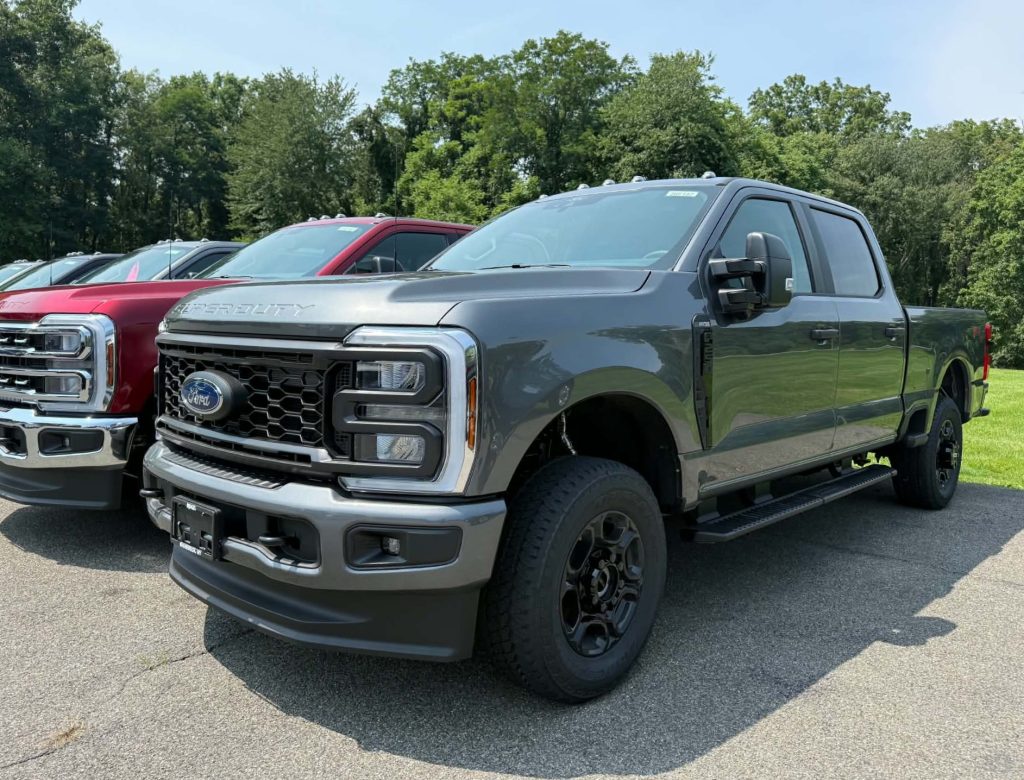
If you’ve been shopping trucks for your trailer, you’ve probably been staring at tow ratings. Totally understandable, it’s the biggest number on the page. But here’s the thing we tell just about every horse owner who walks in: tow rating usually isn’t what limits you. Payload is.
The short version, if you’re in a hurry: a two-horse bumper pull is happy behind an F-250. A three-horse gooseneck with a dressing room usually wants an F-350 single rear wheel. Four horses or living quarters puts you into F-350 dually or F-450 territory.
That last one throws people, because an F-250 is rated to pull way more than a loaded three-horse trailer weighs. So what gives? A gooseneck doesn’t just pull on your truck. A big chunk of it sits on your truck. Let’s walk through how that works, and how to check it yourself in about a minute.
Start Here: The Short Answer by Trailer Type
| Your Trailer | Typical Loaded Weight | Weight on the Truck | What We’d Suggest |
|---|---|---|---|
| 2-horse bumper pull | 5,500 to 6,500 lbs | 600 to 950 lbs tongue | F-250 |
| 2-horse gooseneck with dressing room | 7,500 to 9,000 lbs | 1,500 to 2,200 lbs pin | F-250 or F-350 SRW |
| 3-horse gooseneck with dressing room | 11,000 to 14,000 lbs | 2,200 to 3,500 lbs pin | F-350 SRW |
| 4-horse or living quarters | 15,000 to 18,000 lbs | 3,000 to 4,500 lbs pin | F-350 DRW or F-450 |
These are typical ranges to help you plan, not exact specs. Your trailer’s gross weight is on its VIN plate, and what you actually load varies with horses, tack, water, and hay. A trip to a certified scale with everything loaded is the only way to know your real number, and it’s worth doing once.
Why Payload Runs Out First
Here’s the part that trips everyone up. A gooseneck or fifth-wheel hitch puts 20 to 25 percent of your trailer’s weight straight down onto the truck’s rear axle. A bumper pull puts 10 to 15 percent on the hitch receiver. Either way, that weight counts against payload, which is a totally separate number from tow rating.
Let’s do some real math together. Say you’ve got a three-horse gooseneck with a dressing room. Loaded up with three horses, tack, water, and hay, you’re looking at around 13,000 lbs. At 22 percent, that’s roughly 2,860 lbs pressing down on the bed of your truck. Now add yourself, a friend, a few bags of feed, and the hitch hardware. You’re over 3,100 lbs and you haven’t left the driveway yet.
A nicely equipped crew cab 4×4 F-250 with the diesel often has real-world payload somewhere in the 2,800 to 3,400 lb range, even though that same truck can tow well past 20,000 lbs. So the trailer is nowhere near the tow limit, and the truck is already maxed out. That’s the whole puzzle, and it’s why we usually point three-horse gooseneck folks toward an F-350 SRW instead of a loaded-up F-250.
Gooseneck or Bumper Pull?
Goosenecks just tow better, and most people notice it immediately. The pivot point sits over the rear axle instead of hanging out behind it, so you get way less sway and a much calmer ride in crosswinds and on choppy pavement. They also turn tighter, which you’ll appreciate the first time you’re backing into a tight stall row at a show grounds with people watching.
The tradeoff is that all that stability comes from putting weight on your truck. A bumper pull of the same size asks less of the chassis, but it’s more prone to sway and really wants a weight distributing hitch to behave itself. If you’re running two horses locally a few times a month, a bumper pull behind an F-250 is a perfectly good setup and there’s no reason to overthink it. If you’re hauling a three-horse rig to shows on the regular, the gooseneck is worth the truck it takes.
Gas or Diesel? You Might Be Surprised
This is where a lot of horse folks get sold more truck than they need, and we’d rather just be straight with you about it. The 6.7L Power Stroke is a fantastic engine. If you’re putting on serious towing miles or climbing long grades regularly, it’s the right call, and the high-output version makes a genuinely wild 1,200 lb-ft of torque.
But the diesel and everything that comes with it adds roughly 700 to 800 lbs to the truck. And every single one of those pounds comes right back out of your payload. Since pin weight is the thing squeezing you with a gooseneck, the 7.3L Godzilla gas V8 often leaves you with more usable capacity in the same configuration. It’s also less expensive up front, and you skip diesel exhaust fluid, emissions maintenance, and the cold-start routine that gets old fast in a Hudson Valley February.
For 2026, the 6.8L V8 is standard on XL, XLT, and Lariat, the 7.3L becomes standard on King Ranch and Platinum, and the 6.7L Power Stroke is available on every trim. Our honest read: if you’re towing a loaded three-horse rig more than a few thousand miles a year, or you’re on sustained grades a lot, go diesel. Below that, the 7.3L is usually the smarter buy, and we’ll happily tell you so.
The One-Minute Payload Check
Go open your driver’s door and look at the jamb. There’s a yellow sticker that says “The combined weight of occupants and cargo should never exceed X lbs.” That number is built specifically for your VIN, with your exact cab, bed, drivetrain, engine, and options already baked in. It’s the only payload number that really counts.
Brochure maximums, on the other hand, almost never describe a truck anyone actually drives home. Those peak numbers usually come from a regular cab, two-wheel drive, gas engine, long bed configuration. Add a crew cab, 4×4, the diesel, and a sunroof and you can watch 1,500 lbs or more disappear off that headline figure.
So here’s your check. Take your loaded trailer weight, multiply by 0.22 for a gooseneck or 0.13 for a bumper pull, add everyone and everything riding along, and hold that up against the yellow sticker. If you’re within a few hundred pounds, move up a model. Seriously, go look at the sticker on the truck sitting in your driveway right now. Most people are surprised.
A Note on Hauling Around Here
Brochure numbers assume flat ground and nice weather, which is not exactly what we get. Pulling a loaded rig up the 9G grades, running 199 out toward the Taconic, or crossing the Kingston-Rhinecliff Bridge on a gusty spring afternoon all go a lot better in a truck that has some margin left over instead of one working at its absolute limit.
Whether you’re heading to the Dutchess County Fairgrounds, running the circuit at HITS in Saugerties, or hauling down through Millbrook hunt country, you’re doing plenty of two-lane miles with hills and not much shoulder. In that kind of driving, an integrated trailer brake controller, Trailer Sway Control, and Pro Trailer Backup Assist earn their keep in a hurry. So does a truck that’s genuinely rated for what’s riding on it.
Common Questions
Can an F-250 tow a three-horse gooseneck?
Sometimes, and it comes down to how your truck is configured and what your trailer actually weighs loaded. The limiting factor is payload, not tow rating. A loaded three-horse gooseneck typically drops 2,200 to 3,500 lbs of pin weight onto the truck, which is more than many crew cab 4×4 diesel F-250s have available once you add passengers and gear. A lighter three-horse trailer behind a well-specified F-250 can absolutely work. Check the yellow payload sticker in your driver’s door jamb against your loaded pin weight, and if it’s close, an F-350 single rear wheel is the safer bet.
Do I need a dually to haul horses?
Probably not, unless you’re running a really heavy rig. Dual rear wheels add stability and a lot of payload, which matters for four-horse trailers and living quarters models that can top 15,000 lbs loaded. For two- and three-horse trailers, a single rear wheel F-350 handles it comfortably and is much easier to live with day to day, especially parking and navigating narrow Hudson Valley roads.
Is the diesel worth it for a horse trailer?
It depends on how much you tow. The 6.7L Power Stroke gives you more torque and better control on long grades, but it adds roughly 700 to 800 lbs to the truck, and that comes straight out of payload. Since pin weight is usually what limits you with a gooseneck, the 7.3L gas V8 often leaves you with more usable capacity. If you’re towing several thousand miles a year or climbing sustained grades, go diesel. For mostly local hauling, the 7.3L is frequently the better value.
How much does a loaded horse trailer really weigh?
More than most people guess. An average horse runs 1,000 to 1,200 lbs, and tack, water, hay, and shavings pile on a few hundred more. A two-horse bumper pull usually lands between 5,500 and 6,500 lbs loaded, while a three-horse gooseneck with a dressing room commonly hits 11,000 to 14,000 lbs. Your trailer’s gross weight rating is on its VIN plate, but the only way to know your real number is to run the loaded rig across a certified scale.
What towing features actually matter?
Start with the integrated trailer brake controller, Trailer Sway Control, and the factory gooseneck or fifth-wheel prep package, which gets you the in-bed mounting hardware and wiring. Pro Trailer Backup Assist and Pro Trailer Hitch Assist are a real gift when you’re hooking up alone. And if you can get Onboard Scales and Smart Hitch, they let you read payload and tongue weight directly instead of guessing.
Bring Us Your Trailer Numbers
Honestly, the easiest thing to do is let us run the math with you. Bring in your trailer’s VIN plate weight or a scale ticket and we’ll work it against real trucks on the lot before you commit to anything. If the right configuration isn’t sitting here, we can factory order one built around your trailer rather than talking you into whatever’s out front. Come see us on Route 9G in Rhinebeck, or give us a call and we’ll get started over the phone.
Connect with us


- August 2026
- July 2026
- May 2026
- March 2026
- January 2026
- December 2025
- November 2025
- October 2025
- September 2025
- August 2025
- July 2025
- June 2025
- April 2025
- March 2025
- February 2025
- January 2025
- December 2024
- November 2024
- October 2024
- September 2024
- August 2024
- July 2024
- June 2024
- May 2024
- April 2024
- March 2024
- February 2024
- December 2023
- November 2023
- October 2023
- September 2023
- August 2023
- July 2023
- June 2023
- May 2023
- April 2023
- March 2023
- February 2023
- January 2023
- December 2022
- November 2022
- October 2022
- September 2022
- August 2022
- July 2022
- June 2022
- May 2022
- April 2022
- March 2022
Archives
- Car Trade-in Value
- Ford Bronco for Sale
- Ford Bronco for Sale in Rhinebeck
- Ford Bronco for Sale Near Poughkeepsie
- Ford Bronco Sport for Sale
- Ford Bronco Sport for Sale in Rhinebeck
- Ford Dealer
- Ford Dealer Near Kingston
- Ford Dealer Near Me
- Ford Escape for Sale
- Ford Escape for Sale in Rhinebeck
- Ford Explorer for Sale
- Ford Explorer for Sale in Rhinebeck
- Ford F-150 Dealer
- Ford F-150 for Sale
- Ford F-150 for Sale in Rhinebeck
- Ford F-150 for Sale Near Kingston
- Ford F-150 for Sale Near Poughkeepsie
- Ford F-150 Lightning for Sale
- Ford F-250 for Sale
- Ford F-250 for Sale in Rhinebeck
- Ford F-350 for Sale
- Ford Maverick for Sale
- Ford Maverick for Sale in Rhinebeck
- Ford Mustang Mach-E for Sale
- Ford Mustang Mach-E for Sale in Rhinebeck
- Ford Ranger for Sale
- Ford SUVs
- Ford Trucks for Sale
- Ford Trucks for Sale Near Poughkeepsie
- Ford Trucks for Sale Near Red Hook
- Hudson Ford Dealer
- Kingston Ford Dealer
- New Ford Dealership
- New Paltz Ford Dealer
- Poughkeepsie Ford Dealer
- Red Hook Ford Dealer
- Rhinebeck Ford Dealer
- Ruge's Ford
- Sell My Car
- SUVs for Sale
- Trucks for Sale
- Uncategorized
- Used Car Dealer
- Used Car Dealer in Rhinebeck
- Used Car Dealer Near Kingston
- Used Ford Dealership
- Used Ford F-150 for Sale
- Used Ford F-150 for Sale in Rhinebeck