
Blog

F-150 vs. Ranger Comparison -- Which One is Right for You?

When you need a vehicle that balances everyday usability with serious work capacity, choosing between the full-size Ford F-150 and the midsize Ford Ranger comes down to how you want to use your truck. While both trucks offer incredible durability and modern technology, they serve different operational roles.

If you want to compare these two capable trucks side by side, finding our showroom is simple. You can easily get directions to our dealership to view our current inventory, or you can speak with a truck specialist today by giving us a quick call at 845-876-4440.

Table of Contents

Comparing Exterior Dimensions

Physical size is often the deciding factor for our customers deciding between the F-150 and the Ranger. The Ford F-150 in its typical SuperCrew configuration measures roughly 232 inches in length with a wheelbase of around 145 inches. In comparison, the Ford Ranger SuperCrew is much more compact, measuring roughly 211 inches in length with a wheelbase of around 127 to 129 inches. The Ranger's width without mirrors is roughly 76 inches, making it significantly narrower than its full-size sibling.

This dimensional difference directly impacts maneuverability along with parking. The Ranger can squeeze through narrow gates and park in standard garages without hassle, making it an excellent fit for smaller areas or jobsites. The F-150 offers a commanding presence and an incredibly spacious cabin, but navigating  certain areas will be a bit tougher. 

​

Towing and Payload Capabilities for Heavy Property Maintenance

Heavy property maintenance demands robust hauling capacity, especially for tasks like bringing home loads of topsoil or towing heavy machinery. The 2026 Ford F-150 maximum towing capacity reaches up to 13,500 pounds when equipped with the 3.5L EcoBoost V6, and up to 12,400 pounds with the 3.5L PowerBoost hybrid engine. Its maximum payload capacity reaches up to 2,440 pounds. These numbers provide a clear advantage if you regularly haul heavy building materials, gravel, or large equipment trailers.

In contrast, the Ford Ranger offers a maximum towing capacity of 7,500 pounds and a maximum payload capacity of up to 1,809 pounds with the standard 2.3L EcoBoost I-4 engine. Please note with either vehicle, it's important to reference your owner's guide or consult with us at the dealership to determine exact towing capabilities. When local property owners visit our showroom to compare these models, they often ask to see how a standard sheet of plywood fits in the back before making a decision. The Ranger's redesigned bed provides 4 feet of space between the wheelwells, allowing plywood to lay flat. However, the F-150 offers larger bed sizes, including 5.5-foot, 6.5-foot, and 8-foot configurations, which are better suited for bulky cargo.

​

Winter Driving Performance and Snowplow Compatibility in Cold Weather

Our region's winters bring heavy snowfall and prolonged sub-freezing temperatures, making winter traction a top priority for local truck buyers. Both trucks offer highly capable four-wheel-drive systems designed to tackle slick roads and muddy trails. The heavier weight of the F-150 provides excellent natural traction on packed snow, while the Ranger's narrower track and lighter footprint make it highly agile when navigating unplowed back roads.

A common question among landowners is whether they can clear their own long driveways using a front-mounted plow. Most commercial plow manufacturers do not recommend mounting a standard plow on the Ranger due to front suspension weight limits. If you need a serious snow-clearing machine, the F-150 is the clear choice. When equipped with the available Snowplow Prep Package, the F-150 easily handles a full-size plow to keep your property clear all winter.

​

Real-World Fuel Economy and Daily Driving on Local Roads

Fuel efficiency is a major consideration for drivers who use their truck as a daily commuter and local errand runner. A 4x4 Ranger equipped with the standard 2.3L EcoBoost I-4 delivers an EPA-estimated 21 mpg city / 24 mpg highway / 22 mpg combined. 

On the other hand, a comparable F-150 four-wheel-drive model with the standard 2.7L EcoBoost V6 is rated around 19 mpg city / 24 mpg highway. While the highway mileage is surprisingly close, the Ranger's smaller size and lighter weight make it much more efficient for short, local trips around town where stop-and-go driving dominates. If your daily routine involves frequent quick trips to local shops, the Ranger provides a more efficient and parkable solution.

​

Comparing Resale Value and Long-Term Ownership Costs

Smart truck buyers look beyond the initial purchase price to consider how well a vehicle retains its value over time. Both trucks are highly regarded for their strong resale performance. According to industry resale value studies, full-size pickup trucks retain an average of roughly 60% of their original value after five years, while midsize trucks retain roughly 63%. This means both models represent excellent long-term investments.

The F-150 benefits from massive market demand and immense commercial utility, ensuring it remains highly sought after on the pre-owned market. The Ranger, with its lower entry price and high demand among recreational buyers, offers a highly civilized cabin and excellent long-term value retention. Both trucks are backed by a 3-year/36,000-mile basic warranty and a 5-year/60,000-mile powertrain warranty, giving you peace of mind from day one.

​

Common Questions About Ford Trucks

Q: Can I mount a snowplow on a Ford Ranger?

Standard commercial plows are not recommended for the Ranger due to front suspension weight limits. For serious snow clearing, we recommend the F-150 equipped with the available Snowplow Prep Package.

Q: What is the roadside assistance coverage for these trucks?

Both trucks include a 5-year/60,000-mile roadside assistance warranty backed directly by Ford. This program provides manufacturer-backed service quality, genuine parts, and authorized service center coordination. For immediate help on the road, you can contact Ford Roadside Assistance: 1-800-241-3673.

Q: Is the Ranger a good daily driver for short local trips?

Yes, the Ranger is an excellent daily driver. Its smaller dimensions, comfortable ride, and standard 2.3L EcoBoost I-4 engine make it highly maneuverable and easy to park on local streets.

Q: Which truck has a better turning radius for tight spaces?

The Ranger features a turning diameter of roughly 43 feet, making it much more agile than the F-150, which requires roughly 48 feet depending on the cab and bed configuration.

Q: How do the bed utility features compare between the two models?

The Ranger offers a standard 5-foot bed with a built-in side bed step and an available 400-watt power inverter. The F-150 is highly customizable with 5.5-foot, 6.5-foot, and 8-foot beds, plus advanced features like the Pro Access Tailgate and Pro Power Onboard electrical outlets.

​

Finding Your Next Ford Truck at Ruge's Ford

Finding the perfect truck for local property needs starts with a hands-on comparison at our showroom. Our team is ready to help you explore our current inventory and find the truck that matches your workflow. To test drive both models today, simply get directions to our showroom, or get started by calling our sales department at 845-876-4440.


© 2026 Ruge's Ford. All rights reserved.

2026 Ford F-150 vs. 2026 Ford Ranger: Side by Side

Maximum ratings below apply to specific configurations when properly equipped. Your truck's actual numbers are printed on the yellow sticker inside the driver's door jamb.

SpecificationFord F-150Ford Ranger
Cab configurationsRegular Cab, SuperCab, SuperCrewSuperCrew only
Bed lengths5.5 ft, 6.5 ft, 8.0 ft5 ft only (59.6 in. inside length)
Overall lengthAbout 232 in. (SuperCrew)About 211 in.
Wheelbase145.4 in. (SuperCrew, 5.5-ft box)128.0 in.
Width, excluding mirrorsAbout 80 in.About 75.5 in.
Turning diameterAbout 48 ft.About 43 ft.
Width between wheel wellsAbout 50.6 in.48.2 in. (4x8 sheet lies flat)
Engine options2.7L EcoBoost V6, 3.5L EcoBoost V6, 5.0L V8, 3.5L PowerBoost hybrid2.3L EcoBoost I-4 (270 hp), available 2.7L EcoBoost V6 (315 hp)
Maximum towingUp to 13,500 lbs. (3.5L EcoBoost, SuperCrew 4x4, 6.5-ft box, Max Trailer Tow)Up to 7,500 lbs. with Trailer Tow Package. 3,500 lbs. without it.
Maximum payloadUp to 2,440 lbs. (3.5L EcoBoost, Regular Cab 4x2, 8-ft box)Up to 1,767 lbs. (2.3L EcoBoost 4x2)
Snowplow Prep PackageAvailableNot offered
Best suited forHeavy trailers, long cargo, plowing, crew haulingDaily driving, tight properties, boats and utility trailers

Dimensions and capacities vary by trim, cab, box length, drivetrain, and equipment. Towing and payload maximums cannot be achieved at the same time. Confirm figures for a specific vehicle with our sales team or Ford's published towing guide.

What You Can Actually Haul: Payload Math for Real Loads

Towing gets most of the attention, but payload is what stops people short. Payload is everything you add to the truck: passengers, gear in the cab, cargo in the bed, accessories you bolt on, and the tongue weight of whatever you are pulling. It all counts against one number.

Start with your truck's number, not the brochure number

The F-150's 2,440-pound maximum comes from a Regular Cab, rear-wheel-drive, 8-foot-box work truck. The Ranger's 1,767-pound maximum comes from a rear-wheel-drive 2.3L EcoBoost. Add four-wheel drive, a crew cab, and a higher trim with heavier equipment, and the real figure drops on both trucks. A well-equipped F-150 SuperCrew 4x4 often lands closer to 1,700 pounds than to 2,440.

Where to find it: Open the driver's door and look for the yellow sticker on the jamb. It reads "The combined weight of occupants and cargo should never exceed XXXX lbs." That number is specific to the truck in front of you, and it is the only one that matters.

Subtract this before you load anything

What it isTypical weight
Four adults700 lbs.
Tools, cooler, and gear in the cab100 to 200 lbs.
Hard tonneau cover60 to 90 lbs.
Bed cap or topper150 to 200 lbs.
Cross-bed toolbox, empty100 to 150 lbs.
Drop-in bed linerAbout 50 lbs.
Weight-distributing hitchAbout 100 lbs.

A family of four in a truck with a cap and a toolbox has already used roughly 1,000 pounds before a single shovel of anything goes in the bed. Ford calculates its published maximums assuming a 150-pound driver and a 150-pound passenger and nothing else.

Common Hudson Valley loads, by the numbers

LoadApprox. weightWhat it takes
1 cubic yard of hardwood mulch500 to 800 lbs.Either truck, comfortably
10 bags of 80-lb. concrete mix800 lbs.Either truck, comfortably
Half yard of screened topsoil1,000 lbs.Either truck
20 sheets of 3/4-in. plywood1,300 lbs.Either truck. F-150 with a 6.5-ft. or 8-ft. box carries them without hanging over the tailgate.
Face cord of seasoned hardwood1,200 to 1,500 lbs.Either truck, but close to the Ranger's limit once passengers are aboard
1 cubic yard of dry screened topsoilAbout 2,000 lbs.High-payload F-150 only. Over the limit for the Ranger and for most crew-cab F-150s.
One ton of wood pellets (50 bags)About 2,050 lbs.Split into two trips, or have it delivered
Pallet of sod2,000 to 2,500 lbs.Trailer or delivery
1 cubic yard of crushed stoneAbout 2,700 lbs.Over the limit for both. Order it delivered.
Pallet of 80-lb. concrete mix (42 bags)About 3,400 lbs.Over the limit for both. Two trips minimum.

The pattern is worth noticing. A full yard of anything dense is more truck than most half-ton pickups can legally carry. If your projects run to full yards of stone or gravel, the honest answer is a delivery fee or a trailer, not a bigger pickup.

Tongue weight is the number that catches people

A conventional trailer puts 10 to 15 percent of its loaded weight straight down on the hitch, and that weight lands on the truck's payload, not its tow rating. This is why buyers hit a wall well before they reach the number on the brochure.

Worked example: 24-foot travel trailer, loaded to 7,000 lbs.

Tongue weight at 12 percent: 840 lbs.
Weight-distributing hitch: 100 lbs.
Two adults and two kids: 500 lbs.
Gear, cooler, and firewood: 150 lbs.
Total against payload: 1,590 lbs.

That trailer is well under the Ranger's 7,500-pound tow rating. It is also more payload than a Ranger has left to give, and it puts a mid-trim F-150 SuperCrew 4x4 within a couple hundred pounds of its own limit. Payload runs out first, on both trucks.

What the F-150 buys you here is headroom in the configuration. Higher-payload builds exist on the F-150 and simply do not on the Ranger, and a 6.5-foot box opens up fifth-wheel and gooseneck towing that a midsize truck cannot do at all.

Where each truck lands on common local trailers

  • 17-foot aluminum boat, motor, and trailer (about 2,400 lbs. loaded): Either truck, with room to spare. Tongue weight runs 240 to 360 lbs.
  • Landscape trailer with a zero-turn mower and brush (about 3,500 lbs.): Either truck, though the Ranger needs the Trailer Tow Package to clear the 3,500-pound base rating.
  • Two-horse bumper pull, loaded (about 6,500 lbs.): F-150. The tow rating is within Ranger range, but 650 to 975 lbs. of tongue weight is not.
  • 24-foot travel trailer (7,000 lbs. and up): F-150, and worth a conversation about payload before you buy the camper. Frontal area matters as much as weight on a tall trailer.

Bring us your load, not just your budget

Tell our team what you tow and what you haul and we will run the payload math against specific trucks on the lot before you commit. Call (845) 876-4440 or stop by the showroom in Rhinebeck.
Recommended Posts

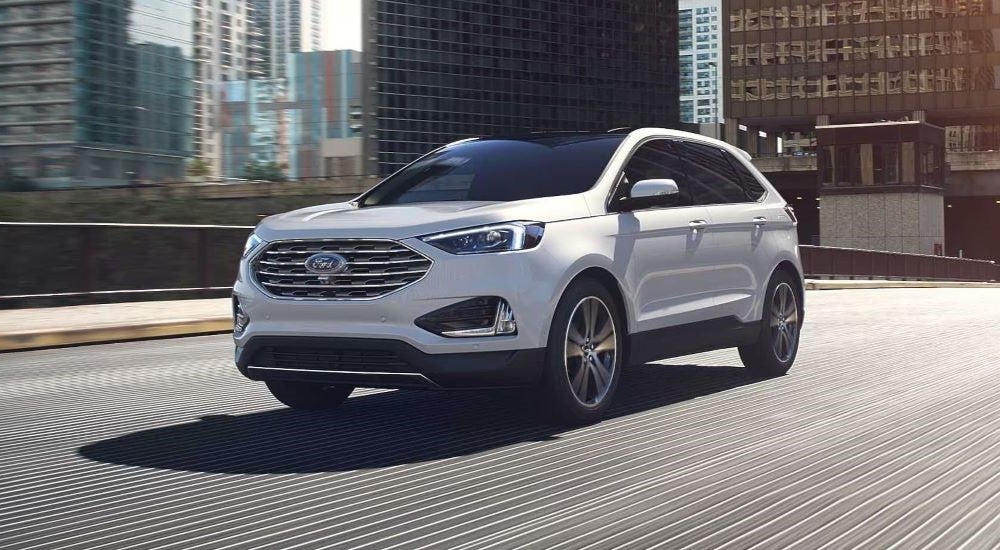
White 2024 Ford Edge driving over a bridge.

Used Vehicles That Make Sense for Commuters and Families of Five

Finding the right vehicle for a family of five can feel like a balancing act. The vehicle needs enough passenger space for school runs, appointments, activities, and weekend trips, but it may also spend much of the week carrying one person to and from work. Choosing a vehicle more than the family needs can increase fuel, insurance, and maintenance expenses, while choosing too little space can make every outing uncomfortable. Upstate New York drivers face additional considerations. Snow, freezing rain, steep roads, potholes, and rapidly changing weather can make traction and predictable handling important. Available all-wheel drive or four-wheel drive may be useful, although neither system replaces suitable tires, careful braking, and speed appropriate for the conditions. The good news is that shoppers comparing used cars for sale have several practical options. Our inventory often includes Ford Escape, Edge, Explorer, Bronco Sport, and Subaru Forester models. Our connection to Chrysler dealerships also makes the Pacifica a realistic pre-owned option. Looking at recent model years from the latest generation or collection of each vehicle can help families find modern safety, comfort, and convenience features without limiting the search to one exact year. Ford Escape: An Adaptable Compact SUV A more recent Ford Escape may suit a commuter who wants SUV versatility without the size of a three-row vehicle. It seats five and provides a rear cargo area that can accommodate groceries, backpacks, luggage, and other household essentials. Its compact exterior can also be easier to park and maneuver during the workweek than a larger family SUV. Recent Escape models have front-wheel drive or available all-wheel drive, depending on the powertrain and trim. Gas, hybrid, and plug-in hybrid versions may also appear in the used market. That variety allows commuters to compare conventional performance with electrified options that may reduce fuel use under appropriate driving and charging conditions. One of the Escape's most useful family features is its sliding second row. Moving the seat rearward can provide more passenger room, while sliding it forward creates additional cargo space. This flexibility is helpful when the vehicle sometimes carries five people and sometimes carries one or two people with more gear. The Escape is still a compact SUV, so families should test the rear seat carefully. Three teenagers or multiple child safety seats may feel tight. Bring the seats, stroller, sports bags, or instruments that the vehicle will regularly carry before deciding whether the Escape provides enough room. Ford Edge: More Space Without a Third Row A recent Ford Edge can be a strong middle-ground option for a five-person family. Our inventory network often features pre-owned Edge models, including versions equipped with all-wheel drive. Although Ford concluded Edge production after the 2024 model year, late examples from its final collection remain relevant to used-SUV shoppers. The Edge has two rows and seating for five. Its wider cabin may make it more comfortable for three passengers sharing the rear bench than a smaller crossover. Because there is no third row occupying the back of the vehicle, the Edge also provides a large, straightforward cargo area for school gear, groceries, luggage, and weekend supplies. This layout works well for a family that wants more room than the Escape provides but does not expect to transport six or seven people. It can also be easier for a commuter to manage than a longer three-row SUV. The tradeoff is that a midsize vehicle generally brings higher fuel and tire costs than a compact crossover. Shoppers should compare those expenses with the practical benefit of the wider cabin. If five people will regularly travel together, the extra room may be worth more than a small difference in operating costs. Ford Explorer: Three-Row Flexibility for Busy Households For families that carpool, travel with relatives, or simply want room to spread out, a recent-generation Ford Explorer deserves consideration. Current and recent Ruge's inventories have included multiple pre-owned Explorer models, making it one of the most realistic examples for this topic. The Explorer offers three rows and seating for up to seven, depending on whether the second row has captain's chairs or a bench. A family of five may not need every seat, but the third row creates useful flexibility. One child can move to the back on a long trip, a friend can join the family, or the third row can fold when cargo space is the priority. Recent Explorer models have also been offered with available Intelligent 4WD and selectable drive modes. Those features may appeal to drivers preparing for the changing upstate New York road conditions. Equipment varies by year and trim, so shoppers should confirm the drivetrain and drive modes on the individual vehicle. Before choosing an Explorer, families should test third-row access with any child-safety seats installed. They should also determine how much cargo room remains when every row is upright. The Explorer is best for households that will genuinely benefit from its flexible seating rather than commuters who would drive with two empty rows most of the time. Subaru Forester: Practical Space and Standard AWD Our broader pre-owned inventory frequently includes Subaru vehicles, making a recent-generation Forester another realistic option. The latest Forester design seats five and includes standard Symmetrical All-Wheel Drive across its lineup. The Forester's taller shape supports good passenger space and a useful cargo area without giving the vehicle an especially large footprint. Wide door openings can make it easier to load children or install child-safety seats, while the rear liftgate provides access for strollers, luggage, or sports equipment. Recent Forester models also include Subaru EyeSight driver-assistance technology as standard equipment. The exact functions can vary, but shoppers may encounter features designed to assist with braking, lane positioning, and following distance. These systems can support an attentive driver during a long commute, although they are not substitutes for driver awareness. The Forester may appeal most to families that want all-wheel drive, a tall cabin, and manageable exterior dimensions. As with the Escape, the second row should be tested with all three expected passengers to confirm that the width works for the family. Chrysler Pacifica: A Family-Focused Alternative A Chrysler Pacifica may not be the first vehicle every commuter considers, but it can be one of the most practical choices for a family of five. Because our dealership network includes Chrysler, Dodge, Jeep, and Ram operations, late-model Pacifica minivans are also often available in our inventory. Recent Pacifica models can seat up to eight, depending on configuration. Sliding side doors make it easier to load passengers in narrow parking spaces, while the flexible interior provides room for school bags, sports equipment, luggage, and other family cargo. Available all-wheel drive distinguishes the Pacifica from many traditional minivan expectations and is ideal for upstate New York families. However, drivetrain and seating features vary, so shoppers should verify the equipment on each vehicle. The Pacifica is larger than a compact SUV, and commuters should consider its fuel, tire, and insurance costs. In return, it can reduce many of the small frustrations associated with family transportation. Parents may spend less time rearranging cargo, separating passengers, or squeezing between parked vehicles to open a conventional rear door. Compare the Complete Ownership Picture Once a family identifies the right vehicle type, the condition of the individual's used vehicle becomes more important than the model name alone. Review its maintenance records and vehicle history report, and consider a pre-purchase inspection. Because winter road treatments are common in our area, the underbody, suspension, brakes, and exposed metal components deserve close attention. Safety features also vary across model years and trims. Confirm whether the specific vehicle includes automatic emergency braking, blind-spot monitoring, rear cross-traffic alert, adaptive cruise control, lane assistance, or other desired systems. Never assume that every example from the same generation has identical equipment. Finally, compare fuel, insurance, maintenance, repair, and replacement-tire estimates. The smaller Escape or Forester may help control commuting expenses. The Edge provides additional width without a third row. The Explorer offers adaptable seating, while the Pacifica delivers maximum family functionality. Choose for the Commute and the Whole Family No single model will suit every household. The best choice is the vehicle that works when the driver is alone on Monday morning and when all five family members are aboard on Saturday. When exploring used cars for sale, families should recreate their normal routine during the evaluation. Install the child seats, bring the stroller or sports bags, sit three people across the rear seat, and drive on roads similar to the daily commute. That practical test can reveal whether a vehicle offers the right balance of comfort, space, winter-ready confidence, and manageable ownership costs.

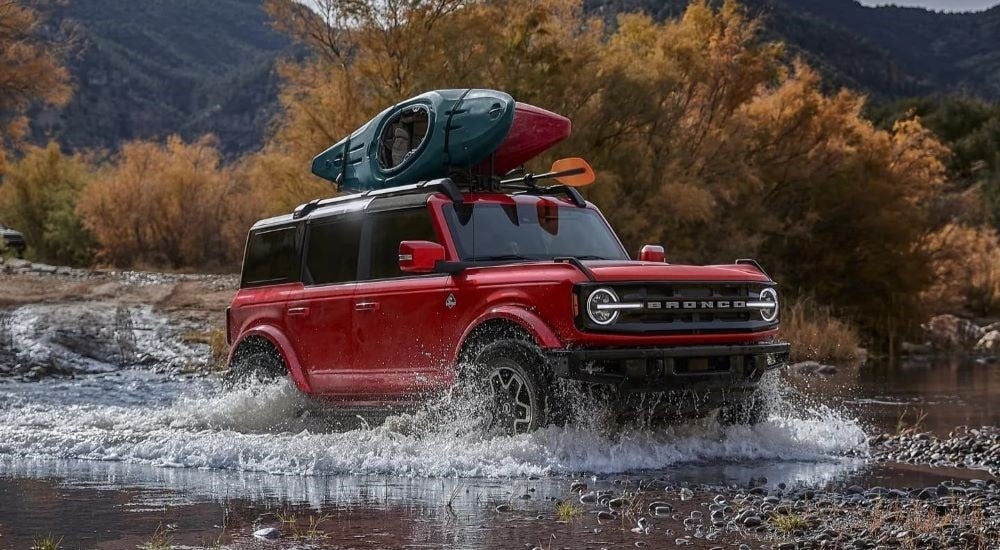
Bronco Off Road

2027 Off-Road Capabilities of the Ford Bronco

What I Tell Drivers About 2027 Ford Bronco Off-Road Capabilities A quick note before we dive in: Everything here is current as of September 2026. Ford hasn't released full 2027 Bronco specs yet, so the numbers below come from the current 2026 lineup and Ford's early 2027 previews. We'll update this post as Ford shares more. Before you order, check with our team for the latest details. How Do Ford Bronco G.O.A.T. Modes Work for Off-Road Driving? Ford Bronco G.O.A.T. Modes (Goes Over Any Type of Terrain) work by adjusting throttle response, shift timing, traction control, and four-wheel-drive engagement to match the conditions you're driving in. You just turn the dial on the center console. Depending on the trim, you'll get five or seven modes. Every Bronco gets Normal, Eco, Sport, Slippery, and Sand. Badlands, Stroppe Edition, and Raptor models add Off-Road, Rock Crawl, and Baja; on those trims, Off-Road takes the place of Sand. Each mode tunes the drivetrain for a specific surface. Slippery softens throttle response and tightens traction and stability control for snow, ice, and wet roads. Sand engages the four-wheel-drive lock for soft sand or deep snow. Off-Road is built for muddy, rutted, or uneven ground. Rock Crawl engages the four-wheel-drive lock and the rear differential lock, and at slow speeds the front trail camera automatically pops up so you can see what's ahead. Baja sharpens suspension and throttle response for high-speed runs over loose terrain. The Bronco also comes with some handy trail tech. Trail Turn Assist brakes the inside rear wheel during slow, tight turns, which shrinks your turning radius on narrow trails. Trail Control works like cruise control for low-speed off-roading, so you can focus on steering on steep climbs and descents. Want to see how these settings work in person? Give our sales team a call or stop by our Rhinebeck showroom. Table of Contents What Are the Ground Clearance and Off-Road Angles of the 2027 Ford Bronco? What Features Are Included in the 2027 Ford Bronco Sasquatch Package Across Trims? Is Independent Front Suspension Better for Off-Roading Than a Solid Front Axle? How Deep Can the Bronco Ford Water and How Do You Maintain the Drivetrain Afterwards? Where Can You Test Drive or Buy a 2027 Ford Bronco Near Rhinebeck NY? What Are the Ground Clearance and Off-Road Angles of the 2027 Ford Bronco? With 35-inch tires, the current Bronco offers up to 11.6 inches of ground clearance on 2-door models and 11.5 inches on 4-door models. Approach angle is 43.3 degrees and departure angle is 37.0 degrees on the 2-door (36.9 on the 4-door). Breakover angle is 28.9 degrees on the 2-door and 26.3 degrees on the 4-door. We expect the 2027 model to land in a similar range. Those numbers let you climb over boulders, crest steep hills, and handle sharp drops without scraping the underside or the bumpers. Ground clearance depends on your tire size and suspension setup. Without the Sasquatch Package, current models range from about 8.3 inches on the Base to 10.5 inches on the Badlands. That's plenty for forest trails and deep snow. If you want maximum clearance, the Bronco Raptor tops the lineup at 13.1 inches. Underbody protection matters when you're really putting that clearance to work. Full-vehicle steel bash plates come standard on the Badlands and are available on other trims through packages like Black Diamond. They help shield important components underneath from rocks and logs. The available heavy-duty modular steel front bumper gives you mounting points for a winch, light pods, and other trail gear, and tow hooks help you recover yourself or a buddy when things get sticky. What Features Are Included in the 2027 Ford Bronco Sasquatch Package Across Trims? The Sasquatch Package adds 35-inch LT315/70R17 rugged-terrain tires on 17-inch alloy wheels, electronic-locking front and rear axles with a 4.7 final drive ratio, high-clearance fender flares, and HOSS 2.0 suspension with Bilstein position-sensitive dampers. For 2026, it comes standard on the Heritage Edition and Stroppe Edition and is available on the Base, Big Bend, Outer Banks, and Badlands. We expect similar availability for 2027. The front and rear electronic lockers make both wheels on an axle turn at the same speed, no matter how much traction each tire has. That means you can keep crawling through mud or over slick rocks even when a couple of tires lose grip. The Bilstein dampers use position-sensitive valving to soften hard hits while keeping things controlled over washboard roads. If you want even more, the FOX internal bypass dampers of HOSS 3.0 are available as a separate upgrade on Badlands, and they come included with the Wildtrak Package. Because Sasquatch is offered on entry-level trims, you can get serious trail capability without jumping to a pricier model. Whether you add it to a Base or an Outer Banks, these factory upgrades mean you can skip the aftermarket lift and tire swap and keep your factory warranty intact. Is Independent Front Suspension Better for Off-Roading Than a Solid Front Axle? Independent front suspension gives you better high-speed control, sharper steering, and a more comfortable ride on dirt roads and highways. A solid front axle is better for extreme low-speed rock crawling articulation. For most drivers, the Bronco's independent front setup, paired with a solid rear axle and the HOSS (High-Performance Off-Road Stability Suspension) system, strikes a great balance between daily driving and real trail capability. A solid front axle sends bumps across the whole front beam. Independent front suspension lets each front wheel react on its own. The result is less steering kickback, less head-toss on uneven ground, and front tires that stay planted when you're moving quickly on dirt. Higher-performance setups build on this. HOSS 3.0 adds FOX internal bypass dampers, front steel bash plates, and a Ford Performance severe-duty steering rack. Solid axles still have their fans among dedicated rock crawlers, but a modern independent front suspension gives you predictable handling whether you're on the interstate or a rutted back road. How Deep Can the Bronco Ford Water and How Do You Maintain the Drivetrain Afterwards? With the Sasquatch Package, the current Bronco is rated for up to 33.5 inches of water fording, and the Bronco Raptor is rated for up to 37 inches. After a deep crossing, check your front and rear differential fluid right away. If it looks milky or shows signs of moisture, replace it. Inside, the Bronco is built for messy days. Available marine-grade vinyl seats resist mildew and grime, and rubberized floor mats with drain plugs let you hose out mud and water afterward. In my 10 years as a Sales Consultant, I always remind off-road drivers that differential breather tubes can end up underwater during deep crossings. When the gear housings cool down quickly, they can pull water in. Checking your axle and transfer case fluids after water runs helps prevent gear corrosion and protects expensive drivetrain parts for the long haul. Your owner's manual has the specific service guidance for your model. Where Can You Test Drive or Buy a 2027 Ford Bronco Near Rhinebeck NY? If you're interested in exploring or custom ordering a 2027 Ford Bronco near Rhinebeck, visit Ruge's Ford to go over trims, option packages, and estimated order timelines. Taking a 2026 Bronco out on local roads is a great way to get a feel for cabin comfort, driving dynamics, and visibility before you lock in an order. We'll help you through every step. Current models offer the 2.3-liter EcoBoost four-cylinder with either a 7-speed manual or a 10-speed automatic, and the 2.7-liter EcoBoost V6 paired with a 10-speed automatic. For 2027, Ford has also previewed two new models. The Bronco RTR uses the 2.3-liter EcoBoost with standard 33-inch tires and Bilstein shocks, and the Sasquatch Package and HOSS 3.0 are available. The Bronco Filson uses a version of the 3.0-liter EcoBoost V6 from the Raptor. Custom factory ordering lets you choose your exact paint, top, and gear packages. Ready to compare models or talk through custom ordering? Stop by our dealership in Rhinebeck or give us a call at (845) 876-4440. © 2026 Ruge's Ford. All rights reserved.

Towing Camper

F-150 Towing Guide for Ruge's Ford

2026 Ford F-150 Towing Guide: Capacity by Trim and Engine Whether you're pulling a boat to the Hudson, a camper up to the Catskills, or a work trailer across the county, the F-150 has a setup for it. The trick is that trim level is only part of the story. Your towing number really comes down to engine, cab, bed length, axle ratio, drivetrain and whether you add the Tow/Haul Package. Here's how it all breaks down, straight from Ford's official specs. Max towing by engine Engine Max Conventional Towing Max Payload 2.7L EcoBoost V6 8,400 lbs 1,775 lbs 3.5L EcoBoost V6 13,500 lbs 2,440 lbs 5.0L Ti-VCT V8 12,800 lbs 2,235 lbs 3.5L PowerBoost Full Hybrid V6 12,400 lbs (4x2) / 11,600 lbs (4x4) 1,740 lbs 3.5L High Output EcoBoost V6 (Raptor) 8,200 lbs 1,405 lbs 5.2L Supercharged V8 (Raptor R) 8,700 lbs 1,410 lbs The top ratings for the 3.5L EcoBoost, 5.0L V8 and PowerBoost all require Tow/Haul Package and Max Tow Axle upgrade. One more thing to keep in mind: horsepower, torque, payload and towing are independent attributes and may not be achieved simultaneously. Engine availability and top tow rating by trim Trim Available Engines Highest Engine Rating Available XL 2.7L EcoBoost, 5.0L V8, 3.5L EcoBoost 13,500 lbs (3.5L EcoBoost) STX 2.7L EcoBoost, 5.0L V8, 3.5L PowerBoost 12,800 lbs (5.0L V8) XLT 2.7L EcoBoost, 5.0L V8, 3.5L EcoBoost, 3.5L PowerBoost 13,500 lbs (Ford's named max tow config) Lariat 5.0L V8, 3.5L EcoBoost, 3.5L PowerBoost 13,500 lbs (3.5L EcoBoost) Tremor 5.0L V8, 3.5L EcoBoost 10,600 lbs (3.5L EcoBoost, Tremor rating) King Ranch 3.5L EcoBoost, 3.5L PowerBoost 13,500 lbs (3.5L EcoBoost) Platinum 3.5L EcoBoost, 3.5L PowerBoost 13,500 lbs (3.5L EcoBoost) Raptor 3.5L High Output EcoBoost 8,200 lbs Raptor R 5.2L Supercharged V8 8,700 lbs A quick heads up: the top ratings above apply to the best-equipped configurations. Ford notes that your specific vehicle's tow capability could be reduced based on weight of selected trim series and option content. So a loaded Platinum won't always match an XLT with the same engine. That's exactly why it's worth sitting down with our team to spec the right truck. Ford What you need to hit max towing For gas trucks, Ford requires the Tow/Haul Package (53T) plus the optional Max Tow Axle for trailers over 11,600 lbs. For the hybrid, the threshold is for trailers over 10,800 lbs. Ford also warns that your New Vehicle Limited Warranty may be voided if you tow without them. 2026 Ford F-150 Towing Information +2 The Tow/Haul Package includes the integrated trailer brake controller and either the 3.55 or 3.73 e-lock rear axle depending on the powertrain. Ford The hitch receiver also changes with the package. A 2" hitch receiver rated at 11,600 lbs. is standard. Max Tow Axle includes 2" reinforced receiver rated at 14,000 lbs. Ford Weight rules worth knowing Use weight distribution over 5,000 lbs. Do not exceed trailer weight of 5,000 lbs. when towing without a weight-distribution system. Ford Tongue weight should be about 10% of the trailer. Trailer tongue load weight should be 10% of total loaded trailer weight. For 5th-wheel and gooseneck trailers, the king pin load should be 15% of total loaded trailer weight. Ford Ford Count people and cargo against payload. Your payload has to cover the tongue weight, your passengers and whatever's in the bed. Watch the trailer's frontal area. Ford's limit is 55 sq. ft. for vehicles with Trailer Tow Rating of 7,700 lbs. or less, 65 sq. ft. for vehicles with Trailer Tow Rating of 7,701 lbs. and greater and 75 sq. ft. for all 5th-Wheel and Gooseneck applications. Ford Heading into the mountains? At elevation, Ford recommends you reduce Gross Vehicle Weight (GVW) and Gross Combination Weight (GCW) by 2% per 1,000 ft. elevation. Ford Bring a matching spare. A conventional, identical full-size spare tire is required for trailer towing. Ford Raptor owners, skip the 5th-wheel. 5th-wheel towing is not recommended for Raptor model. Ford Towing tech that makes life easier Every F-150 comes with trailer sway control, a 7-wire harness, a hitch receiver, a transmission oil cooler and Tow/Haul mode. The Lariat and up add a 360-Degree Camera, Pro Trailer Backup Assist and Pro Trailer Hitch Assist as standard. With Pro Trailer Backup Assist, you simply rotate in the direction you want the trailer to go, and it'll move your truck and trailer into position. Pro Trailer Hitch Assist steers, accelerates and brakes for you, as it guides your truck into place for easy hitching to your conventional trailer. Towing FAQ What's the max towing capacity of the 2026 F-150? 13,500 lbs with the 3.5L EcoBoost V6. Ford's top configuration is the XLT SuperCrew 4x4 with the 6.5' box, the Tow/Haul Package and the Max Tow Axle. How much can the F-150 hybrid tow? Up to 12,400 lbs on a 4x2 SuperCrew and up to 11,600 lbs on a 4x4, when properly equipped. How much can the F-150 Tremor tow? Up to 10,600 lbs with the 3.5L EcoBoost and 10,000 lbs with the 5.0L V8. Do I need the Tow/Haul Package? If you're towing over 11,600 lbs with a gas engine, or over 10,800 lbs with the hybrid, yes. You'll need the Tow/Haul Package and the Max Tow Axle. Where do I find my truck's exact ratings? See label on doorjamb for carrying capacity of a specific vehicle. The axle code is on the same Safety Compliance Certification Label. Or just stop by, and we'll walk through it with you!