
Blog / SUVs for Sale

Five Options, Endless Possibilities: The 2026 Ford SUV Lineup

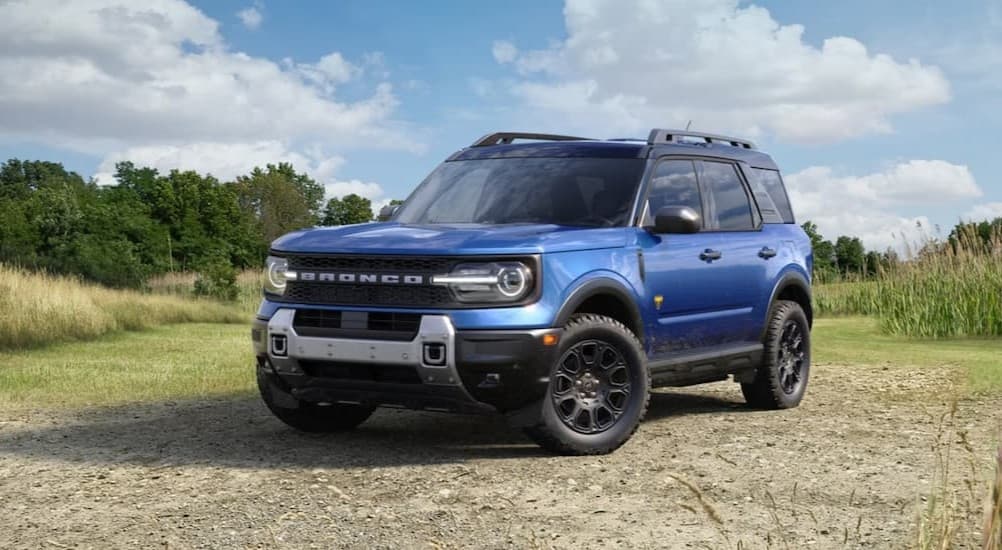
A blue 2026 Ford Bronco Sport parked off-road.

When searching for new SUVs for sale, it's hard to beat America's homegrown brand: Ford. This brand is a force to be reckoned with thanks to its F-Series pickups and the iconic Mustang, but the company also offers one of the market's most well-rounded lineups of SUV offerings.

The current roster ranges from efficient SUV hybrid and EV options to versatile midsize models and larger body-on-frame models that truly put the "utility" in "sport utility vehicle." The return of the Bronco has boosted the brand's SUV fortunes, with the famous nameplate driving sales of the new body-on-frame and SUV models. 

There's a lot to keep track of as we enter 2026, including new off-road trims, appearance packages, and some important updates to Ford's infotainment software. The new year also marks a bittersweet occasion as the Ford Escape ends its 25-year run. Let's take a quick spin through the 2026 lineup and see which Ford SUV is right for you. 

Ford Bronco Sport 

Category: Subcompact SUV

While the Escape has been discontinued, Ford already offers a suitable replacement in the Bronco Sport. Designed as a lighter-duty version of the readymade adventure rig that is the midsize Bronco, the subcompact SUV can accomplish many of the same off-road antics while delivering a more efficient, comfortable ride on paved surfaces. It's a winning combination, and one that's seen the Bronco Sport become one of Ford's most popular models over the last five years, routinely ranking right alongside the larger Bronco in terms of sales. 

The Bronco Sport returns largely unchanged for the 2026 model year, aside from the addition of a new Bronze Package, but it's a well-deserved rest after the momentous year that was 2025. 

The Bronco Sport has always offered some level of off-road ability, but Ford gave the SUV a big shot in the arm last year with a new Sasquatch Package that ups the model's go-anywhere attitude. A twin-clutch rear drive unit ensures consistent traction while steel bumpers, skid plates, and recovery hooks protect the Bronco Sport from the ravages of the off-road lifestyle. The Sasquatch-Package-equipped SUV also adds a set of Bilstein rear dampers and 29-inch all-terrain tires and offers 8.8 inches of ground clearance. 

As one of Ford's newer models, the Bronco Sport is also equipped with a slick array of modern tech. This includes an available 13.2-inch infotainment display, 12.3-inch digital gauge cluster, and even an available 400-watt power inverter that'll keep all of your electronics juiced up when you're far off the grid. 

Ford Bronco

Category: Midsize SUV

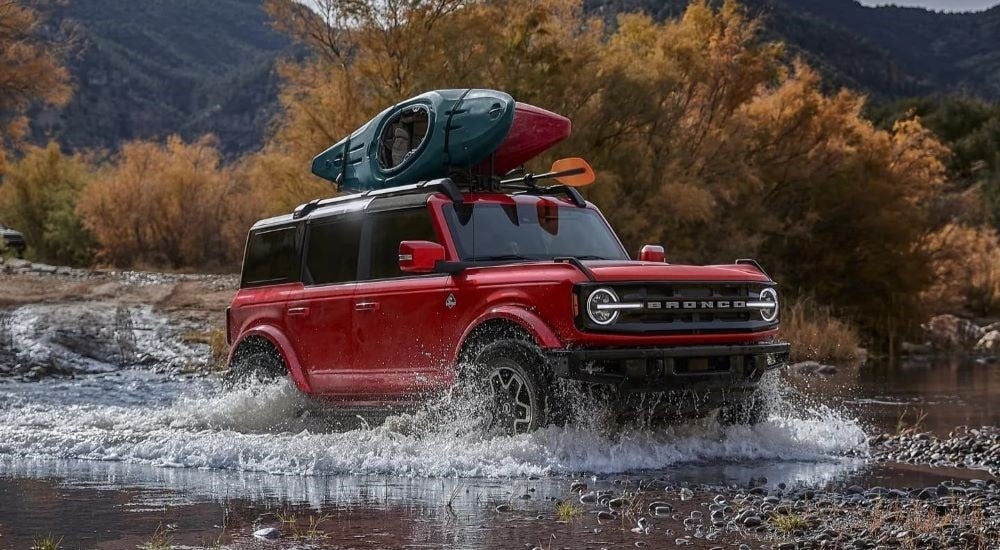
If you'll settle for nothing but the best in an off-road model, look no further than the midsize Bronco. 

The industry's first SUV returned in 2021 after a quarter-century hiatus, and has already lived up to its impressive reputation in just the last five years. Lauded for its rugged design and robust HOSS (High-Performance Off-Road Stability Suspension) system, the Bronco is here to kick up some mud and defy conventional physics with its rock-scaling abilities. 

The Badlands is the go-to trim for those who prefer to take the road less traveled, thanks to its 33-inch all-terrain tires, upgraded suspension with Bilstein dampers, and a GOAT (Goes Over Any Type of Terrain) system with seven dedicated modes. The Ford Bronco's available Sasquatch Package brings comparable off-road ability to nearly the entire lineup. The package includes 35-inch all-terrain tires, electronically locking front and rear axles, 11.6 inches of ground clearance, and a 4.7 drive ratio that delivers maximum torque when you need it most.   

Of course, it takes more than heavy-duty components to find success in challenging off-road environments. Luckily, Ford has provided the Bronco with all of the power it needs to muscle through, with the base model boasting a 300-hp turbocharged engine with an available seven-speed manual transmission that gives drivers plenty of control. If you're in the market for more power, the Bronco has you covered with a potent V6 that returns 330 hp and 415 lb-ft of torque. 

Finally, there's the high-performance beast that is the Bronco Raptor. Inspired by the high-speed desert racing circuit, the Raptor pulls out all of the stops to provide buyers with 418 hp and a zero-to-60-mph time of just 5.6 seconds. It's also capable of towing as much as 4,500 lbs.  

Ford Explorer

Category: Midsize SUV

Automotive success stories don't come much larger than the Ford Explorer. This three-row SUV has been one of the segment's bestselling models for over three decades, and posted a class-leading 223,000 sales in 2025 alone. 

The Explorer has earned a stellar reputation as a reliable family vehicle that isn't afraid to live on the wild side, especially with the addition of the new-for-2026 Tremor trim. The Explorer's seven-passenger design and 85.8 cu.ft. of cargo space make it well-prepared for carpool duty and extended road trips. Even the base engine can pull as much as 5,000 lbs. The Explorer is one of the most versatile models in the 2026 lineup, and can be easily customized to fill a specific niche in your automotive quiver. 

Need an efficient daily driver that packs an impressive raft of safety tech? 

Active: An efficient daily driver that achieves up to 29 MPG on the highway and comes standard with the comprehensive Ford Co-Pilot360 Assist+ safety suite.

ST-Line: A style-focused trim featuring eye-catching upgrades such as black exterior trim and a unique cloth with red stitching on synthetic leather upholstery.

ST: The performance-oriented version that backs up its aggressive styling with a 400-hp V6 engine, a sport-tuned suspension, and high-performance front brakes.

Tremor: The dedicated off-road model equipped with a lifted suspension, all-terrain tires, steel skid plates, a limited-slip differential, and grille-mounted auxiliary lights for trail adventures.

Platinum: A refined, range-topping trim featuring a panoramic fixed glass roof, leather seating surfaces, and heated second-row captain's chairs. It also boasts a premium 14-speaker Bang & Olufsen sound system and unique luxury accents throughout the cabin.
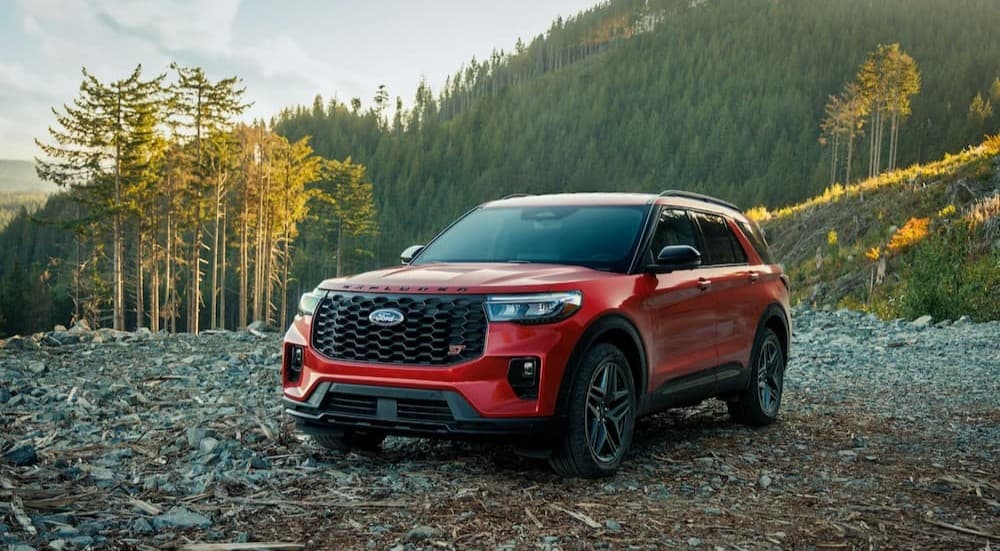
A red 2026 Ford Explorer ST parked off-road.

Ford Expedition

Category: Full-size SUV 

Ford's largest body-on-frame SUV comes in two distinct forms: the standard model and an extended-wheelbase MAX version that offers some of the best cargo capacity in the segment. The base model is certainly no slouch with up to 108.5 cu.ft. of storage, but the MAX's cavernous dimensions are hard to beat with the larger SUV offering up to 123.1 cu.ft. Throw in the ability to seat as many as eight passengers, and you'll soon understand why so many drivers have welcomed the Expedition into the family. 

Like many of the models on our list, the Expedition can be equipped with Ford's industry-leading BlueCruise technology. The autonomous driving system provides drivers with a new way to enjoy life behind the wheel, bringing a true hands-free experience on 97% of controlled-access highways across the US and Canada. The system has won plenty of praise from drivers and critics alike, and was named the best hands-free system on the market by Consumer Reports with an 84/100 score that saw it top competing offerings from GM (75/100), Toyota (65/100), and Hyundai/Kia/Genesis (59/100).

Cutting-edge autonomous driving tech aside, it's the Expedition's sheer size and power that really draws most buyers to the three-row Ford. Even the base engine manages to churn out 400 hp, and the available High Output version sees that figure rise to 440 with 510 lb.ft. of torque for good measure. Do drivers really need a full-size SUV that can sprint from zero to 60 mph in 4.9 seconds as they cruise through town? Maybe not, but it'll sure inject a little more excitement into your weekly grocery run. The full-size model can also tow 9,600 lbs, and is equipped with a full suite of modern towing tech.  

Ford Mustang Mach-E

Category: Compact Electric SUV 

Finally, we have Ford's Mustang-inspired SUV EV in the Mach-E. The model's efficient, all-electric design is an obvious selling point, but the EV powertrain also allows the SUV to live up to the thoroughbred reputation of its pony car predecessors. Sure, the Mach-E might not be able to match the pure acceleration of the 815-hp high-performance beast that is the 2026 Mustang GTD, but the two models are more evenly matched than you might assume. While the gas-powered GTD posts a zero-to-60-mph time of 2.8 seconds, the EV has been known to reach the achievement in as little as 3.3 seconds when opting for some of the higher trims. 

Customization is key when it comes to the Mach-E, which can be equipped with your choice of five different powertrains, including both single- and dual-motor designs. The entry-level offering is built around a 73-kWh battery and a single motor to offer 264 hp and 260 miles of range, while the 88-kWh, single-motor setup offers the most range at 320 miles. The 88-kWh, dual-motor design is probably the most well-rounded, with 370 hp and 300 miles of range, but the GT and Rally models can be paired with a massive 91-kWh battery that sees the trims produce 480 hp and as much as 700 lb.ft. of torque.     

The Mach-E offers a tech-forward cabin to match its advanced EV powertrain. The dashboard features a 15.5-inch touchscreen infotainment display that provides plenty of room to navigate through various connectivity and convenience features like wireless Apple CarPlay and Android Auto, while an available 10-speaker Bang & Olufsen offers buyers a high-fidelity listening experience. Voice-activated climate controls make for a seamless driving experience, and go a long way towards reducing the number of distractions you'll need to deal with when you're behind the wheel. The EV also offers a wide array of advanced driver-assistance systems (ADAS), but the Mach-E really seals the deal amongst safety-conscious drivers thanks to its standard BlueCruise hands-free system. 
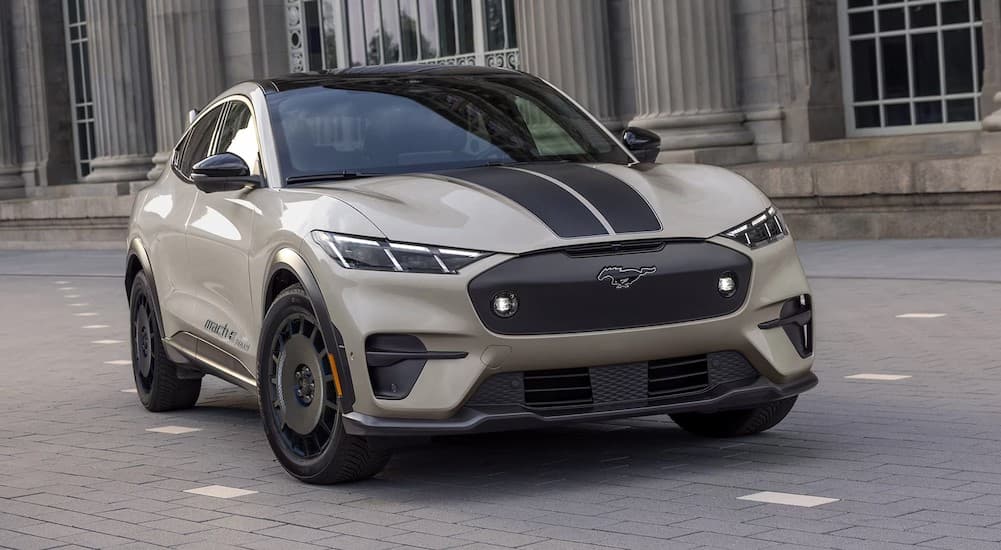
A tan 2026 Ford Mustang Mach-E parked near a building.

A Selection That's Second To None 

From smaller options like the Bronco Sport to popular three-row models, including the Explorer and Expedition, there's a Ford SUV that's sure to fit the needs of every driver. The Mach-E marks the most recent addition to the lineup and proves that efficiency doesn't have to come at the cost of performance. The EV also does the Mustang name proud with an engaging ride that'll leave a lasting impression, and is easy on your wallet with its low operating costs. 

Ford's SUVs are only improving with age, and are committed to keeping things fresh with new off-road options, equipment packages, and other available add-ons that allow buyers to build a one-of-a-kind.

When you're ready to welcome a new SUV into the family, Ruge's Ford is here to help. We carry a wide selection of both new and used Ford models, including a full lineup of 2026 models, and are eager to leverage our considerable experience to help narrow down your options and ensure a satisfying result.  
Posted in:

Recommended Posts

2027 Ford Explorer: What to Love

If you've spent any time on Route 9, the Taconic, or a gravel road heading toward a trailhead, you already know why the Explorer has been a Hudson Valley staple for so long. It's the rare three-row SUV that hauls the whole family without feeling like a chore to drive. The 2027 Ford Explorer keeps everything that made that reputation, and adds a few things worth getting excited about. Here's what we love about it, and who each version is really built for. It Still Drives Like Something You Chose, Not Settled For This is the part people underestimate until they get behind the wheel. The Explorer is built on a rear-wheel-drive platform, which is unusual in this class, and you can feel it. The steering has actual weight to it. The nose doesn't wash out when you take an on-ramp with a little enthusiasm. It just feels planted in a way a lot of family SUVs don't. Two turbocharged EcoBoost engines carry the lineup. The 2.3L EcoBoost four-cylinder is standard on Active, ST-Line, Tremor, and Platinum, and it puts out 300 horsepower and 310 lb-ft of torque on premium fuel. That's genuinely plenty. It's not a base engine you tolerate, it's an engine you'd pick on purpose. Step up to the 3.0L twin-turbocharged EcoBoost V6 and you get 385 horsepower and 415 lb-ft, again on premium. It's standard on the ST and available on the Tremor. Both engines pair with a 10-speed automatic, and both offer rear-wheel drive with available Intelligent 4WD. You also get up to six selectable drive modes: Normal, Eco, Sport, Tow/Haul, Slippery, and either Trail or Off-Road depending on the model. Slippery alone earns its keep around here. Ask anyone who's driven Route 199 in February. The Tremor Is the One We Keep Talking About The Explorer Tremor is the model that surprised a lot of people, and it carries into 2027 with all its hardware intact. This isn't an appearance package with some stickers and a lift. Ford gave it real equipment. You get a Torsen limited-slip rear axle, which is the big one. It helps send torque to the wheel that still has grip instead of the one spinning uselessly in the mud. There's an off-road tuned suspension with increased ride height, bringing minimum running ground clearance to 8.7 inches versus 7.6 on the standard models. Underneath, front and rear deflector plates protect the components you'd rather not replace. Outside, the Tremor rides on 18-inch high gloss Ebony Black wheels wrapped in all-terrain tires, with accent-color tow hooks, off-road auxiliary lights, and Tremor badging and grille. The geometry backs it up too: a 24.1-degree approach angle and 23.7-degree departure angle, both meaningfully better than the rest of the lineup. Inside, it doesn't feel like a work truck. You get heated front and second-row seats with a stitched Tremor logo, front and second-row floor liners, and a B&O Sound System by Bang & Olufsen with 10 speakers including a subwoofer. It's a fishing-access-road SUV that's still perfectly pleasant on the commute. That combination is genuinely hard to find. One thing to know: the Tremor comes with Intelligent 4WD standard and seats six, not seven. If you need the seventh seat, one of the other models is your answer. The ST Gets a Dark Side for 2027 The Explorer ST has always been a bit of a magic trick. A three-row family SUV that runs a twin-turbo V6, sport-tuned suspension, performance brakes with red-painted calipers, and a quad-tipped exhaust shouldn't be as good as it is. But it works, and a big share of Explorer buyers reach for it. New for 2027 is the ST Sinister Package, and it's exactly what the name suggests. You get 21-inch gloss black-painted wheels, ST badges outlined in black, and unique accent lighting including amber daytime running lights that give the whole front end a different character at dusk. It's a genuinely striking look, and the best part is that you're not locked into black paint. The regular color palette stays open, so a Sinister ST in Rapid Red or Star White reads very differently than one in Agate Black. All three are worth seeing in person. If you like the ST attitude but want something a little more restrained, the ST-Line gives you 20-inch Ebony-painted machined wheels, black exterior accents, and unique cloth seats with red stitching, all with the 2.3L engine underneath. Sportier look, gentler fuel bill. Room for the People and All of Their Stuff Three rows only matter if the third one is usable and the cargo area doesn't disappear when you fold it up. The Explorer does well on both counts. You get 16.3 cubic feet behind the third row, which is enough for a real grocery run or a weekend's worth of duffel bags with everyone aboard. Drop the third row and you're at 46 cubic feet. Fold everything and you have up to 85.8 cubic feet on Active and ST-Line models, or 85.3 on ST, Platinum, and Tremor. Seating runs six or seven depending on how you configure it. Second-row captain's chairs are standard on every model except ST-Line, which comes with the bench. The bench is available on all models except the Tremor. PowerFold third-row seats are standard on ST and Platinum and available on Tremor, which is one of those features you don't think about until you've used it in a parking lot with your hands full. The Platinum is where the comfort features really stack up. Heated, ventilated, and massaging front-row seats with leather inserts, the 980-watt 14-speaker B&O system, ambient lighting, adaptive headlamps, and an available panoramic fixed glass roof with a power sunshade. That roof, by the way, is available on every Explorer except the Active 100A, so you don't have to jump to the top of the lineup to get it. The 13.2-Inch Screen Actually Earns Its Space Big screens are easy. Big screens that are pleasant to use are harder. The Explorer runs Ford Digital Experience on a 13.2-inch center touchscreen, and it's genuinely well sorted. Google Maps is built right in, so you get live traffic and road conditions without tethering your phone. Google Assistant handles voice commands. You can download apps from Google Play directly to the center screen. Sign in with your Google account and it pulls in your saved destinations, which means the first drive in a new Explorer already knows where you're going. Wireless Apple CarPlay and Android Auto are along for the ride if you'd rather stick with your phone's setup. The Ford Connectivity Package, included for a year, adds unlimited Wi-Fi for up to 10 devices within about 50 feet of the vehicle, plus streaming apps, podcasts, and yes, karaoke and games while you're parked. That last one sounds like a gimmick right up until you're waiting out a downpour in a trailhead lot with two kids in the back. BlueCruise Makes a Long Drive Boring, in the Best Way Ford BlueCruise is hands-free highway driving on pre-qualified stretches of divided highway called Blue Zones. It handles steering, keeps you centered, and adjusts your speed while a driver-facing camera confirms your eyes are still on the road. The newer Automatic Lane Change feature is what pushes it over the line for us. When BlueCruise detects slower traffic ahead, it can initiate the lane change, accelerate past, and merge back in, all without you touching the wheel. On a Thruway run to Albany or a holiday drive south, that adds up. BlueCruise comes equipped on the ST and Platinum, and it's optional on ST-Line and Tremor. Platinum includes a one-year plan plus a 90-day trial. Towing Comes Standard, on Every Single One This is our favorite quiet detail about the Explorer. Every model comes with the Class III Tow Package standard. Not optional, not bundled into a package you have to hunt for on the order sheet. Standard. That gets you a Class III hitch receiver, a seven-wire harness, and four- and seven-pin trailer connectors, good for up to 5,000 pounds with either engine. Enough for a small camper, a pair of jet skis, an aluminum fishing boat, or a loaded utility trailer. Ford backs it up with the supporting cast too. Trailer Sway Control works with AdvanceTrac and Roll Stability Control to brake and adjust engine power if things start to move around back there. BLIS includes Trailer Coverage, extending blind spot monitoring along the length of what you're pulling. And side-wind stabilization, standard on every model, helps hold your line when a gust comes across an open stretch of road. Anyone who's crossed the Kingston-Rhinecliff Bridge on a windy day will appreciate that one. So Which One Is Yours? Here's the short version. Active is the value play, and it doesn't feel stripped. Heated front seats, heated steering wheel, power liftgate, the full 13.2-inch screen, and Ford Co-Pilot360 Assist+. ST-Line is for the buyer who wants the sport look and the 20-inch wheels without the V6 fuel bill. Tremor is for anyone whose weekends involve leaving the pavement. Torsen rear axle, all-terrain tires, real underbody protection. Platinum is the comfort pick. Massaging seats, 14-speaker B&O, adaptive headlamps, BlueCruise included. ST is for the person who refuses to give up a fun car just because they now need three rows. Add the Sinister Package and it looks the part. 2027 Ford Explorer FAQs How much can the 2027 Ford Explorer tow? Up to 5,000 pounds on every model. The Class III Tow Package is standard across the lineup and includes a Class III hitch receiver, a seven-wire harness, and four- and seven-pin trailer connectors. Both the 2.3L EcoBoost four-cylinder and the 3.0L EcoBoost V6 are rated at the same 5,000-pound maximum. How many people does the 2027 Explorer seat? Six or seven, depending on how it's configured. Second-row captain's chairs are standard on every model except the ST-Line, which comes with a second-row bench. The bench is available on all models except the Tremor, which seats six. Every Explorer has a third row. What is the ST Sinister Package? It's a new-for-2027 appearance package for the Explorer ST. It adds 21-inch gloss black-painted wheels, ST badges outlined in black, and unique accent lighting including amber daytime running lights. You aren't limited to black paint, so it can be ordered with the standard ST color palette. How much cargo space does the 2027 Explorer have? You get 16.3 cubic feet behind the third row, 46 cubic feet behind the second row, and up to 85.8 cubic feet with both rear rows folded on Active and ST-Line models. ST, Platinum, and Tremor models max out at 85.3 cubic feet. Which 2027 Explorer models come with BlueCruise? BlueCruise hands-free highway driving comes equipped on the Explorer ST and Platinum, and it's available as an option on ST-Line and Tremor. Platinum includes a one-year plan plus a 90-day trial. The system now includes Automatic Lane Change, which can pass slower traffic without you touching the wheel. Is the Explorer Tremor good in snow? It's well equipped for it. The Tremor comes with Intelligent 4WD standard, a Torsen limited-slip rear axle that helps route torque to the wheels with traction, all-terrain tires, and 8.7 inches of minimum running ground clearance. Every Explorer also offers a Slippery drive mode. Winter tires are still worth considering if you regularly drive unplowed roads. Come Drive One Specs on a page only get you so far. The Explorer is one of those vehicles where ten minutes behind the wheel tells you more than an hour of research, especially if you're deciding between the Tremor and the ST. They're very different personalities on the same excellent bones. Stop by and see what we have on the lot, or reach out and we'll help you build the one you actually want. No pressure, just a straight conversation about what fits your driveway and your weekends. Browse 2027 Ford Explorer Inventory Specifications, features, and availability are based on manufacturer information and are subject to change. Horsepower and torque ratings achieved using premium fuel. Maximum towing capacity requires proper equipment and configuration. Ford BlueCruise requires an active plan and operates on pre-qualified sections of divided highway. Driver-assist features are supplemental and do not replace attentive driving. Please confirm details on the window sticker or with a product specialist before purchase.

Cargo area behind the third row of the 2027 Ford Expedition MAX

2027 Ford Expedition vs. Expedition MAX | Ruge's Ford, Rhinebeck NY

2027 Ford Expedition vs. Expedition MAX: Size, Cargo, Towing, and Price Compared The 2027 Ford Expedition MAX is 11.8 inches longer than the standard Expedition, and every inch of that goes to cargo behind the third row — not to passenger room. The MAX carries 37.4 cubic feet behind an upright third row versus 22.9 in the standard model, plus a larger 27.8-gallon fuel tank. Passenger space is identical in all three rows. The tradeoff is towing: with the Heavy-Duty Trailer Tow Package, a 4x4 Expedition is rated for 9,600 lbs and a 4x4 Expedition MAX for 9,000 lbs. Both body styles ride on the same body-on-frame platform, use the same 3.5L EcoBoost V6 engines and 10-speed automatic, and share the same 24-inch panoramic display and 13.2-inch center screen. The MAX adds 9.0 inches of wheelbase (122.5 to 131.5 inches) and 2.8 inches of rear overhang. Front overhang is unchanged, and so is every published interior dimension. To compare both body styles side by side or schedule a test drive, call our team at (845) 209-1636 or visit our Rhinebeck showroom. On This Page How do the Expedition and Expedition MAX compare in size and cargo? Do they have different engines, fuel economy, or towing ratings? What does the extra length change day to day? When is the standard Expedition the better value? What's new for the 2027 Expedition? Frequently asked questions Find your Expedition at Ruge's Ford A note on drivetrains: every figure on this page reflects 4x4 configurations. Ford also builds 4x2 versions of most trims, but we stock 4x4 exclusively for Hudson Valley winters, so those are the numbers that will apply to the vehicle you actually drive home. How Do the 2027 Expedition and Expedition MAX Compare in Size and Cargo? The 2027 Expedition MAX measures 221.7 inches long on a 131.5-inch wheelbase, compared to 209.9 inches on a 122.5-inch wheelbase for the standard model. That extra 11.8 inches adds 14.5 cubic feet of cargo volume behind the third row and up to 11.8 inches of usable cargo floor length — 102.2 inches in a MAX Platinum versus 90.4 inches in a standard Platinum with the rear rows folded. Both models are 80.0 inches wide excluding mirrors, 94.6 inches with mirrors extended, and 84.6 inches with mirrors folded. Height is within a tenth of an inch of identical. The two SUVs feel the same in a travel lane; the difference shows up in the parking lot and the cargo hold. Cargo volume, side by side Ford publishes two sets of cargo figures. The first reflects the seats in their standard position; the second reflects Ford's "optimized" measurements, with the third row fully upright and the second row slid fully forward. Both are shown below so you can compare like for like. Measurement Expedition 4x4 Expedition MAX 4x4 Difference Behind third row (standard position) 21.6 cu ft 36.1 cu ft +14.5 Behind third row (third row full upright) 22.9 cu ft 37.4 cu ft +14.5 Behind second row (standard position) 60.8 cu ft 75.4 cu ft +14.6 Behind second row (second row full forward) 69.9 cu ft 84.5 cu ft +14.6 Behind first row (maximum) 108.5 cu ft 123.1 cu ft +14.6 Maximum cargo length (Platinum) 90.4 in 102.2 in +11.8 Fuel capacity 23.6 gal 27.8 gal +4.2 Base curb weight 5,670 lbs 5,796 lbs +126 Passenger volume 175.0 cu ft 175.0 cu ft None Source: Ford.com published specifications for the 2027 Expedition. Expedition Tremor passenger volume is 171.8 cu ft. The third row is exactly the same in both This is the single most common misconception we hear on the lot. The MAX does not add legroom. Ford publishes identical figures for both body styles in every row: 41.1 inches of second-row legroom (42.2 with the seat slid fully rearward), 36.5 inches of third-row legroom (43.5 with the second row slid fully forward), and 37.4 inches of third-row headroom. Third-row shoulder room differs by a tenth of an inch, 64.2 versus 64.3. If your reason for considering the MAX is that a taller teenager or an adult will be riding in the back, the standard Expedition gives you the same seat. The MAX buys you room for what goes behind them. How the extra length is distributed Front overhang is 38.1 inches on both models. The MAX adds 9.0 inches of wheelbase and 2.8 inches of rear overhang. Practically, that means the driver's seating position and the view over the hood are unchanged — the entire difference sits behind you. How the MAX compares to a Suburban The 2026 Chevrolet Suburban is the closest cross-shop at 226.3 inches long, with 41.5 cubic feet behind the third row and 144.7 cubic feet maximum. It holds more cargo than the Expedition MAX. It also tows less — Chevrolet rates the Suburban at up to 8,200 lbs, against 9,600 lbs for a properly equipped Expedition 4x4 and 9,000 lbs for the MAX 4x4. If cargo volume is the deciding factor, the Suburban wins on paper. If you are pulling a boat or a camper, the Expedition has roughly 800 to 1,400 lbs more capability depending on configuration. Do the Expedition and Expedition MAX Have Different Engines, Fuel Economy, or Towing Ratings? Engines and EPA ratings are identical between the two body styles. Towing ratings are not. The standard-wheelbase Expedition is rated 600 lbs higher, and both ratings require the optional Heavy-Duty Trailer Tow Package — without it, neither model reaches its headline number. Configuration Axle ratio GCWR Max trailer weight Expedition 4x4 with Heavy-Duty Trailer Tow Package 3.73 15,900 lbs 9,600 lbs Expedition MAX 4x4 with Heavy-Duty Trailer Tow Package 3.73 15,600 lbs 9,000 lbs Expedition Tremor 4x4 with Heavy-Duty Trailer Tow Package 3.73 with electronic-locking rear differential — 9,300 lbs The 600-lb gap comes from two places. Ford assigns the MAX a Gross Combined Weight Rating of 15,600 lbs versus 15,900 for the standard model, and the MAX carries about 126 lbs more curb weight — 5,796 lbs against 5,670 lbs at base. Even at 9,000 lbs, a MAX handles most double-axle campers, horse trailers, and boats comfortably. If you are near the top of that range, bring us your trailer's loaded weight and tongue weight and we will check it against the specific vehicle's door-jamb sticker before you commit. Engines and fuel economy Every 2027 Expedition and Expedition MAX uses a 3.5L EcoBoost V6 producing 400 horsepower and 480 lb-ft of torque, paired with a 10-speed automatic with SelectShift. A High-Output version of the same engine makes 440 horsepower and 510 lb-ft; it is standard on the Tremor and available on Platinum and MAX Platinum. Horsepower and torque ratings are measured on premium fuel per the SAE J1349 standard, though Ford recommends regular unleaded. Ford publishes the same EPA-estimated ratings for both body styles in 4x4 form: 15 mpg city / 22 mpg highway / 18 mpg combined. The MAX's larger 27.8-gallon tank does change real-world range meaningfully. At the combined estimate, a MAX covers roughly 500 miles between fills against about 425 miles for the standard model — close to 75 extra miles, or one fewer stop on a run to Vermont or the Adirondacks. What Does the Extra Length Actually Change Day to Day? The most common question we get on the lot is whether the extra foot makes the MAX hard to live with. In practice, three things change and one thing does not. Parking and garages. At 221.7 inches, the MAX is 18.5 feet long. A typical single-car garage bay runs 20 to 22 feet deep, so it fits — but the working clearance drops to about a foot and a half at each end in a 20-foot bay, before you account for shelving, a chest freezer, or a garage door track. Measure your bay before you decide. Many older homes in Rhinebeck, Red Hook, and Millbrook have garages built well under 20 feet. Steep driveways and dirt roads. The MAX gives up a little ground geometry. Departure angle drops from 23.3 to 22.2 degrees and ramp breakover from 19.1 to 17.3 degrees. Minimum running ground clearance is the same 8.7 inches on both. If you regularly crest a steep apron at the end of a driveway, the standard model has a small edge. The Tremor, which is standard-wheelbase only, is the meaningful step up here at 10.6 inches of clearance and a 28.2-degree approach angle. Fuel stops. The larger tank means fewer of them, as covered above. What does not change: width, height, seating position, front overhang, and every interior dimension. The MAX is not harder to thread through a narrow lane or a parking structure than the standard model — both are 94.6 inches across the mirrors and roughly 78 inches tall. Both body styles include a standard 360-Degree Camera System, and BlueCruise hands-free highway driving is available on Active and equipped on Platinum, Tremor, and King Ranch models. The multifunction Ford Split Gate is standard across the lineup, with powered upper and lower gates and a 500-lb capacity when used as a loading platform or tailgate seat. The available Cargo Tailgate Manager adds a 35-lb shelf, table, or backrest. When Is the Standard Expedition the Better Value? Across every trim that offers both, the MAX body style adds exactly $3,000 to base MSRP. That is a straightforward calculation: you are paying about $207 per additional cubic foot of cargo space behind the third row. Trim (4x4) Expedition Expedition MAX MAX upcharge Active $66,600 $69,600 $3,000 Platinum $73,550 $76,550 $3,000 Tremor $82,400 Not offered — King Ranch $86,670 $89,670 $3,000 Base MSRP for 4x4 models, excluding a $2,795 destination and delivery charge, taxes, title, and options. Pricing is subject to change — contact us for current figures on in-stock vehicles. Choose the standard Expedition if: You tow near the top of the range and want the full 9,600-lb rating Your third row is usually folded, in which case 60.8 cubic feet is already generous Your garage is under 20 feet deep, or you park on the street regularly You have a steep driveway apron where the extra departure angle helps You want the Tremor, which is only built on the standard wheelbase You would rather put the $3,000 toward a higher trim Choose the Expedition MAX if: You routinely fill six to eight seats and need to carry luggage at the same time You carry long items — the 102.2-inch cargo floor swallows full sheets of plywood or a kayak You drive long distances and value the 4.2-gallon larger tank Your trailer is comfortably under 9,000 lbs loaded What's New for the 2027 Ford Expedition? The Expedition was fully redesigned for 2025, so 2027 is a refresh rather than an overhaul. The notable changes: 30th Anniversary Appearance Package on Platinum models, marking 30 years of the Expedition. It includes 30th Anniversary badging, 22-inch Ebony-painted bright-machined wheels, and exclusive access to Blue Ember Metallic paint. Three new exterior colors: Bronze Fire Metallic Tinted Clearcoat and Nocturnal Blue Metallic on select models, plus the Platinum-exclusive Blue Ember Metallic. An acoustic laminated windshield is now standard across the lineup. The Ford Security Package is included for one year, then available by monthly subscription or as a one-time seven-year purchase at the time of sale. Frequently Asked Questions Is the third row bigger in the Expedition MAX? No. Ford publishes identical interior dimensions for both body styles. Third-row legroom is 36.5 inches in each, expanding to 43.5 inches with the second row slid fully forward, and third-row headroom is 37.4 inches in both. Third-row shoulder room differs by one tenth of an inch. The MAX adds cargo room behind the third row, not passenger room in it. Which tows more, the Expedition or the Expedition MAX? The standard-wheelbase Expedition. With 4x4 and the Heavy-Duty Trailer Tow Package it is rated at 9,600 lbs, against 9,000 lbs for a comparably equipped Expedition MAX. The Heavy-Duty Trailer Tow Package is required to reach either figure. The Tremor, which is 4x4 only and standard-wheelbase only, is rated at 9,300 lbs. Why does the Expedition MAX tow 600 lbs less? Two factors. Ford assigns the Expedition MAX 4x4 a Gross Combined Weight Rating of 15,600 lbs, compared to 15,900 lbs for the standard-wheelbase model. The MAX also carries roughly 126 lbs more curb weight because of its longer frame, bodywork, and glass. Together those reduce the maximum allowable trailer weight from 9,600 lbs to 9,000 lbs. How much cargo space is behind the third row in each model? The standard 2027 Expedition offers 22.9 cubic feet behind an upright third row, and the Expedition MAX offers 37.4 cubic feet — a difference of 14.5 cubic feet. With the seats in their standard position, the figures are 21.6 and 36.1 cubic feet. Maximum cargo volume with both rear rows folded is 108.5 cubic feet for the standard model and 123.1 for the MAX. How long is the 2027 Expedition MAX, and will it fit in a standard garage? The Expedition MAX is 221.7 inches long, or 18.5 feet, compared to 209.9 inches for the standard model. It fits in most 20- to 22-foot garage bays, but with limited working clearance at each end in a 20-foot bay. Both models are 94.6 inches wide including mirrors and 84.6 inches with the mirrors folded. Measuring your bay depth and door opening before ordering is worth the five minutes. Does the Expedition MAX get worse fuel economy? No. Ford publishes the same EPA-estimated ratings for both body styles in 4x4 form: 15 mpg city, 22 mpg highway, and 18 mpg combined. The MAX also carries a larger 27.8-gallon fuel tank versus 23.6 gallons, which extends its range between fill-ups by roughly 75 miles. Is the Tremor trim available in the Expedition MAX body style? No. The Expedition Tremor is built exclusively on the 122.5-inch standard wheelbase, which preserves its off-road geometry: 10.6 inches of minimum running ground clearance, a 28.2-degree approach angle, and a 24.3-degree departure angle. Buyers who want the extended body must choose Active, Platinum, or King Ranch. How many people does the 2027 Expedition seat? Seating depends on trim, not body style. Expedition Active and MAX Active seat up to eight as standard, with front captain's chairs and second- and third-row benches. Platinum, MAX Platinum, and Tremor seat seven as standard with second-row captain's chairs, and eight is available with the second-row bench. King Ranch and MAX King Ranch seat seven. What warranty coverage comes with the 2027 Ford Expedition? Every 2027 Expedition and Expedition MAX includes a 3-year/36,000-mile bumper-to-bumper limited warranty and a 5-year/60,000-mile powertrain limited warranty. Coverage also includes a 5-year/60,000-mile safety restraint system warranty, 5-year/unlimited-mileage corrosion perforation coverage, and a 5-year/60,000-mile roadside assistance program. Find Your 2027 Expedition or Expedition MAX at Ruge's Ford The decision usually comes down to one question: do you regularly need all three rows occupied and a full load of gear at the same time? If yes, the MAX earns its $3,000. If your third row lives folded flat, the standard Expedition gives you nearly the same maximum cargo volume, a higher 9,600-lb tow rating, and an easier vehicle to park. Our team can park both body styles next to each other on the lot, walk you through the 24-inch panoramic display and the Split Gate, and run your actual trailer weight against the right rating for the configuration you are considering — not the headline number. Browse our available inventory, call (845) 209-1636, or stop by our Rhinebeck showroom for a test drive. Specifications, pricing, and availability sourced from Ford.com and are subject to change without notice. Figures shown reflect 4x4 configurations. EPA-estimated ratings for comparison purposes only; actual mileage will vary. Towing capacity requires proper equipment and varies by configuration — always confirm against the vehicle's door-jamb sticker and owner's manual before towing.

What Size Super Duty Do You Need for a Horse Trailer?

If you've been shopping trucks for your trailer, you've probably been staring at tow ratings. Totally understandable, it's the biggest number on the page. But here's the thing we tell just about every horse owner who walks in: tow rating usually isn't what limits you. Payload is. The short version, if you're in a hurry: a two-horse bumper pull is happy behind an F-250. A three-horse gooseneck with a dressing room usually wants an F-350 single rear wheel. Four horses or living quarters puts you into F-350 dually or F-450 territory. That last one throws people, because an F-250 is rated to pull way more than a loaded three-horse trailer weighs. So what gives? A gooseneck doesn't just pull on your truck. A big chunk of it sits on your truck. Let's walk through how that works, and how to check it yourself in about a minute. Start Here: The Short Answer by Trailer Type Your Trailer Typical Loaded Weight Weight on the Truck What We'd Suggest 2-horse bumper pull 5,500 to 6,500 lbs 600 to 950 lbs tongue F-250 2-horse gooseneck with dressing room 7,500 to 9,000 lbs 1,500 to 2,200 lbs pin F-250 or F-350 SRW 3-horse gooseneck with dressing room 11,000 to 14,000 lbs 2,200 to 3,500 lbs pin F-350 SRW 4-horse or living quarters 15,000 to 18,000 lbs 3,000 to 4,500 lbs pin F-350 DRW or F-450 These are typical ranges to help you plan, not exact specs. Your trailer's gross weight is on its VIN plate, and what you actually load varies with horses, tack, water, and hay. A trip to a certified scale with everything loaded is the only way to know your real number, and it's worth doing once. Why Payload Runs Out First Here's the part that trips everyone up. A gooseneck or fifth-wheel hitch puts 20 to 25 percent of your trailer's weight straight down onto the truck's rear axle. A bumper pull puts 10 to 15 percent on the hitch receiver. Either way, that weight counts against payload, which is a totally separate number from tow rating. Let's do some real math together. Say you've got a three-horse gooseneck with a dressing room. Loaded up with three horses, tack, water, and hay, you're looking at around 13,000 lbs. At 22 percent, that's roughly 2,860 lbs pressing down on the bed of your truck. Now add yourself, a friend, a few bags of feed, and the hitch hardware. You're over 3,100 lbs and you haven't left the driveway yet. A nicely equipped crew cab 4x4 F-250 with the diesel often has real-world payload somewhere in the 2,800 to 3,400 lb range, even though that same truck can tow well past 20,000 lbs. So the trailer is nowhere near the tow limit, and the truck is already maxed out. That's the whole puzzle, and it's why we usually point three-horse gooseneck folks toward an F-350 SRW instead of a loaded-up F-250. Gooseneck or Bumper Pull? Goosenecks just tow better, and most people notice it immediately. The pivot point sits over the rear axle instead of hanging out behind it, so you get way less sway and a much calmer ride in crosswinds and on choppy pavement. They also turn tighter, which you'll appreciate the first time you're backing into a tight stall row at a show grounds with people watching. The tradeoff is that all that stability comes from putting weight on your truck. A bumper pull of the same size asks less of the chassis, but it's more prone to sway and really wants a weight distributing hitch to behave itself. If you're running two horses locally a few times a month, a bumper pull behind an F-250 is a perfectly good setup and there's no reason to overthink it. If you're hauling a three-horse rig to shows on the regular, the gooseneck is worth the truck it takes. Gas or Diesel? You Might Be Surprised This is where a lot of horse folks get sold more truck than they need, and we'd rather just be straight with you about it. The 6.7L Power Stroke is a fantastic engine. If you're putting on serious towing miles or climbing long grades regularly, it's the right call, and the high-output version makes a genuinely wild 1,200 lb-ft of torque. But the diesel and everything that comes with it adds roughly 700 to 800 lbs to the truck. And every single one of those pounds comes right back out of your payload. Since pin weight is the thing squeezing you with a gooseneck, the 7.3L Godzilla gas V8 often leaves you with more usable capacity in the same configuration. It's also less expensive up front, and you skip diesel exhaust fluid, emissions maintenance, and the cold-start routine that gets old fast in a Hudson Valley February. For 2026, the 6.8L V8 is standard on XL, XLT, and Lariat, the 7.3L becomes standard on King Ranch and Platinum, and the 6.7L Power Stroke is available on every trim. Our honest read: if you're towing a loaded three-horse rig more than a few thousand miles a year, or you're on sustained grades a lot, go diesel. Below that, the 7.3L is usually the smarter buy, and we'll happily tell you so. The One-Minute Payload Check Go open your driver's door and look at the jamb. There's a yellow sticker that says "The combined weight of occupants and cargo should never exceed X lbs." That number is built specifically for your VIN, with your exact cab, bed, drivetrain, engine, and options already baked in. It's the only payload number that really counts. Brochure maximums, on the other hand, almost never describe a truck anyone actually drives home. Those peak numbers usually come from a regular cab, two-wheel drive, gas engine, long bed configuration. Add a crew cab, 4x4, the diesel, and a sunroof and you can watch 1,500 lbs or more disappear off that headline figure. So here's your check. Take your loaded trailer weight, multiply by 0.22 for a gooseneck or 0.13 for a bumper pull, add everyone and everything riding along, and hold that up against the yellow sticker. If you're within a few hundred pounds, move up a model. Seriously, go look at the sticker on the truck sitting in your driveway right now. Most people are surprised. A Note on Hauling Around Here Brochure numbers assume flat ground and nice weather, which is not exactly what we get. Pulling a loaded rig up the 9G grades, running 199 out toward the Taconic, or crossing the Kingston-Rhinecliff Bridge on a gusty spring afternoon all go a lot better in a truck that has some margin left over instead of one working at its absolute limit. Whether you're heading to the Dutchess County Fairgrounds, running the circuit at HITS in Saugerties, or hauling down through Millbrook hunt country, you're doing plenty of two-lane miles with hills and not much shoulder. In that kind of driving, an integrated trailer brake controller, Trailer Sway Control, and Pro Trailer Backup Assist earn their keep in a hurry. So does a truck that's genuinely rated for what's riding on it. Common Questions Can an F-250 tow a three-horse gooseneck? Sometimes, and it comes down to how your truck is configured and what your trailer actually weighs loaded. The limiting factor is payload, not tow rating. A loaded three-horse gooseneck typically drops 2,200 to 3,500 lbs of pin weight onto the truck, which is more than many crew cab 4x4 diesel F-250s have available once you add passengers and gear. A lighter three-horse trailer behind a well-specified F-250 can absolutely work. Check the yellow payload sticker in your driver's door jamb against your loaded pin weight, and if it's close, an F-350 single rear wheel is the safer bet. Do I need a dually to haul horses? Probably not, unless you're running a really heavy rig. Dual rear wheels add stability and a lot of payload, which matters for four-horse trailers and living quarters models that can top 15,000 lbs loaded. For two- and three-horse trailers, a single rear wheel F-350 handles it comfortably and is much easier to live with day to day, especially parking and navigating narrow Hudson Valley roads. Is the diesel worth it for a horse trailer? It depends on how much you tow. The 6.7L Power Stroke gives you more torque and better control on long grades, but it adds roughly 700 to 800 lbs to the truck, and that comes straight out of payload. Since pin weight is usually what limits you with a gooseneck, the 7.3L gas V8 often leaves you with more usable capacity. If you're towing several thousand miles a year or climbing sustained grades, go diesel. For mostly local hauling, the 7.3L is frequently the better value. How much does a loaded horse trailer really weigh? More than most people guess. An average horse runs 1,000 to 1,200 lbs, and tack, water, hay, and shavings pile on a few hundred more. A two-horse bumper pull usually lands between 5,500 and 6,500 lbs loaded, while a three-horse gooseneck with a dressing room commonly hits 11,000 to 14,000 lbs. Your trailer's gross weight rating is on its VIN plate, but the only way to know your real number is to run the loaded rig across a certified scale. What towing features actually matter? Start with the integrated trailer brake controller, Trailer Sway Control, and the factory gooseneck or fifth-wheel prep package, which gets you the in-bed mounting hardware and wiring. Pro Trailer Backup Assist and Pro Trailer Hitch Assist are a real gift when you're hooking up alone. And if you can get Onboard Scales and Smart Hitch, they let you read payload and tongue weight directly instead of guessing. Bring Us Your Trailer Numbers Honestly, the easiest thing to do is let us run the math with you. Bring in your trailer's VIN plate weight or a scale ticket and we'll work it against real trucks on the lot before you commit to anything. If the right configuration isn't sitting here, we can factory order one built around your trailer rather than talking you into whatever's out front. Come see us on Route 9G in Rhinebeck, or give us a call and we'll get started over the phone. Call 845-876-4440